
Wellness Protocol
Everyday support. One simple liquid.
SHOP WELLNESS
Everyday support. One simple liquid.
SHOP WELLNESS
Cellular energy + healthy aging support.
SHOP PROTOCOL
Daily support for skin, coat, eyes + gut.
SHOP ESSENTIALS
Weight, metabolism, heart + vitality support.
EXPLORE CAT PROTOCOL
Senior dog health
PERSPECTIVE · Senior dog health
After 24 years of veterinary practice, I can tell you most vets are only masking the stiffness while the real cellular damage compounds underneath. The dog keeps declining. The prescriptions keep escalating. The root cause stays untouched.


Every week, someone sits across the exam table from me and describes the same dog.
“He doesn’t meet me at the door anymore.”
“She sleeps straight through dinner.”
“Last night he stood at the bottom of the stairs and just looked at me.”
Different dogs. Same story.
The bloodwork comes back fine. The X-rays show a little wear, nothing dramatic.
And for most of my career, I said exactly what I’d been trained to say.
He’s just getting old.
For 24 years, I sent slowing dogs home with the same short list.
Try a joint chew.
Switch to a senior food.
Let him rest more.
Come back if it gets worse.
They came back. Stiffer. Thinner. Quieter. Sleeping a little more at every visit.
Not because their owners weren’t trying. These were people who carried 70-pound dogs up the stairs every night.
They came back because nothing on my list was ever going to reach what was actually happening.
I was treating each sign on its own. The hips here. The appetite there. The long naps, the shorter walks, the nights pacing the hallway.
Nobody had ever shown me what was sitting underneath all of them.
The day I finally saw it, I felt two things.
Relief, because the picture finally made sense.
And shame, because I had been the one in the white coat telling good people there was nothing more to do.

Here is what nobody in this business wants you to figure out.
A slowing senior dog is one of the steadiest customers in pet care.
Count what he brings in every month. The joint chews. The senior food. The pain medication refill. The recheck that ends with “normal for his age.”
Each one is sold for a single sign. Each one is bought again next month.
And the whole cycle depends on one thing.
Your dog never quite getting better.
Think about that for a moment.
The people who make these products aren’t villains. Most of what they sell does a real job. If your vet has prescribed something for his pain, that isn’t on trial here.
It’s just never the whole job.
They’re built to manage the slide, not to get underneath it. Comfortable enough to keep buying. Never well enough to stop.
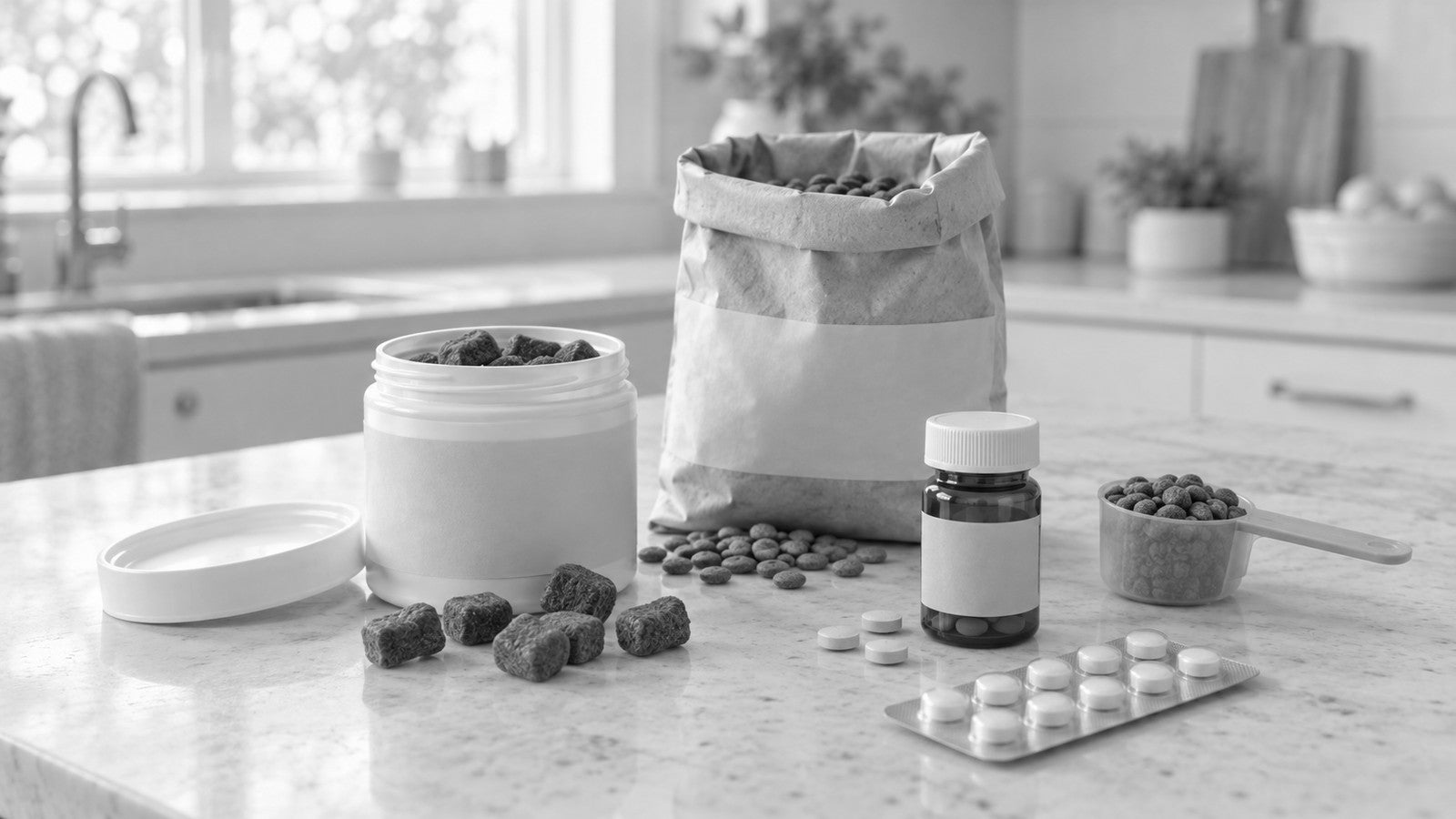
Joint chews work on the joint. That’s what they’re built to do.
But the dog who won’t take the stairs isn’t only stiff. Very often, he’s tired before he’s sore.
A senior food changes what goes into the bowl. It doesn’t change what happens inside the cells that have to turn that food into energy.
Pain medication quiets the ache. When your vet prescribes it, it matters, so keep giving it as directed.
But it was never designed to give back the energy that age takes.
And rest? Rest is the trap.
The less he moves, the less muscle he keeps. The less muscle he keeps, the less he wants to move.
It’s like pumping up a car’s tires while the battery quietly runs down.
Every one of those answers works on the outside of the problem. The part that’s running down is on the inside.
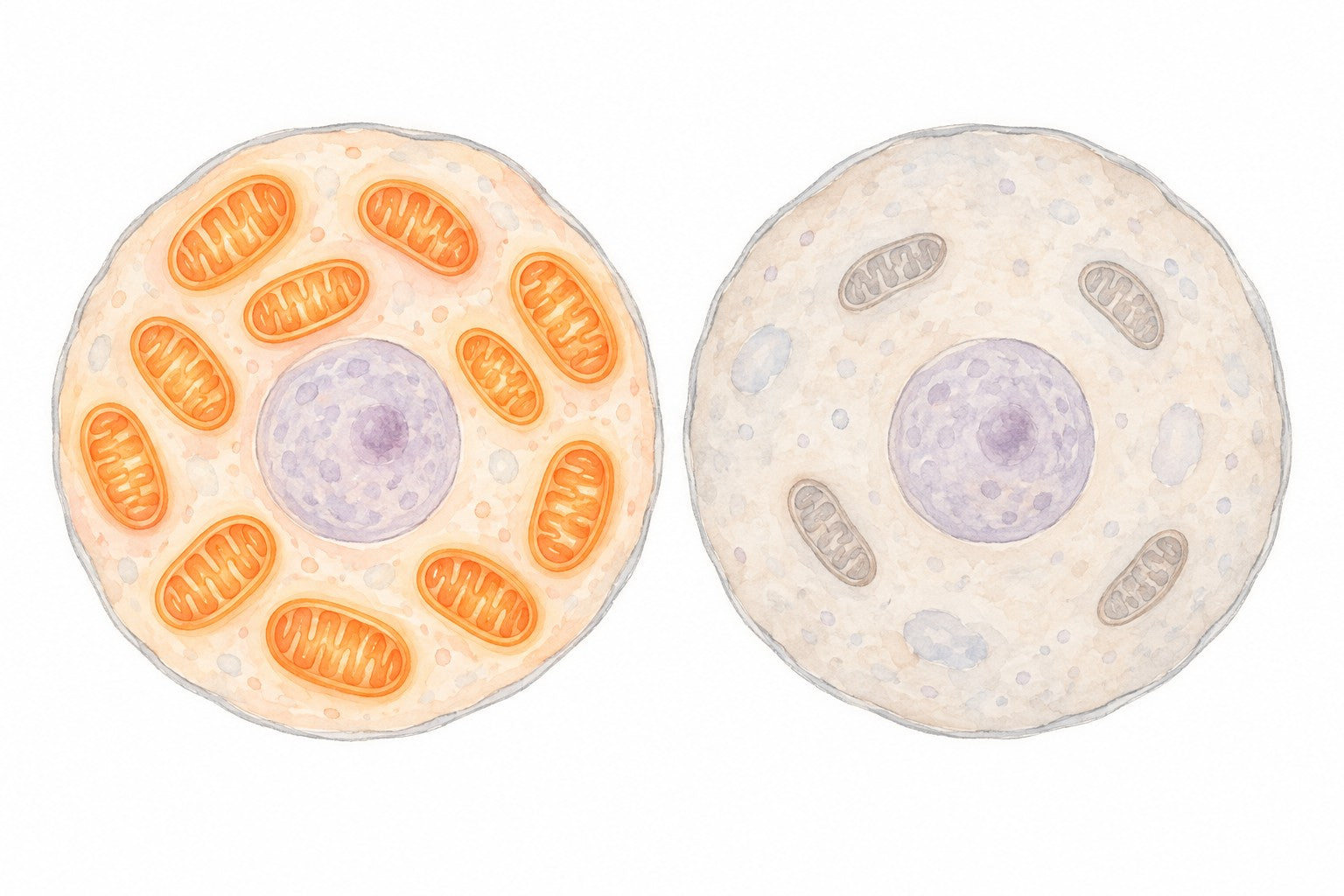
Every cell in your dog’s body makes its own energy.
That work happens in mitochondria, tiny power plants that turn food into usable energy. Muscle, brain and heart cells are packed with them, because they work the hardest.
To do that work, those power plants spend a helper molecule called NAD+.
In people, NAD+ is widely reported to fall with age, though researchers still argue about how universal that is. In dogs, the question is still being studied. After 24 years of watching dogs slow down, I know what I’d bet on.
And in dogs, lean mass peaks in middle age and declines from there.
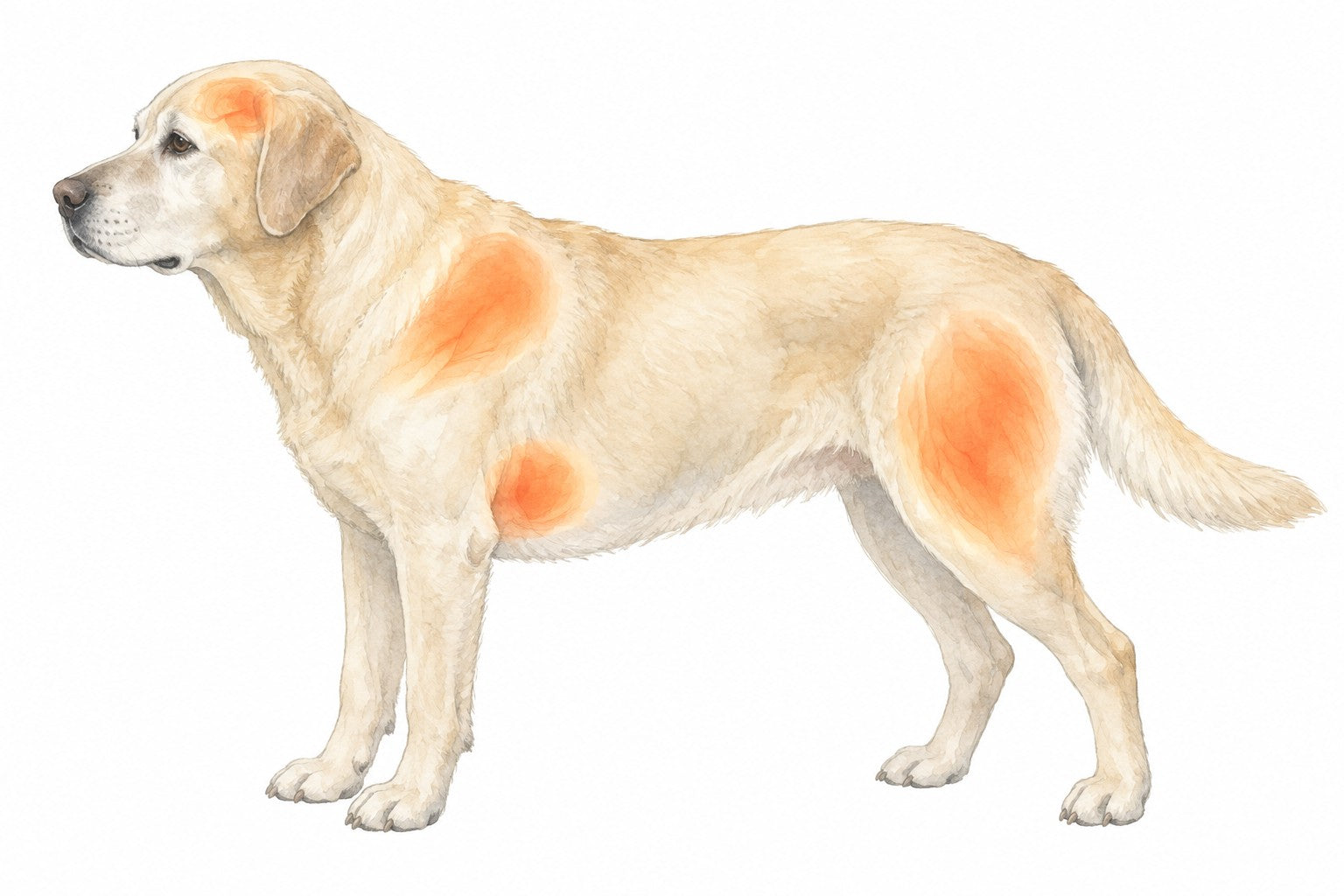
Here’s what that looks like from your side of the couch.
Less cellular energy, so he tires sooner.
He tires sooner, so he moves less.
He moves less, so he keeps less muscle.
Less muscle, so every walk costs him more.
Less energy. Less movement. Less muscle. More sleep. More “he’s just getting old.”
Around and around. A little more every month.
And the loop keeps running, because nothing on that old list ever reached the supply line.
This isn’t your dog giving up on you.
It’s what happens when everything you’re handed treats the sign and nothing feeds the cell.
One thing I learned the hard way: not every change in an older dog is this loop. If something changed fast or on one side only, if he’s in pain, coughing, losing weight you can’t explain, or confused in a way that’s new, that’s a vet visit, not a supplement. Get him seen.
To get underneath this, two things have to happen.
One: refill the supply. Give his cells the raw material they use to make NAD+.
Every day, not once in a while. In a placebo-controlled trial in people, daily NMN raised blood NAD+ over 12 weeks, and levels fell back once it stopped. Job one is a daily job.
Two: get it where it’s needed. In a form built to be absorbed, not just swallowed, and simple enough to give every single day.
Miss either one and the loop restarts.
Not one thing on my old list was built to refill that supply every day.
In 24 years, I had never recommended anything that did both jobs.
When I finally went looking, I did not expect the answer to be a few droppers of liquid on a dog’s breakfast.
But when I read the label on Pawprint Protocol, it was hard to argue with.
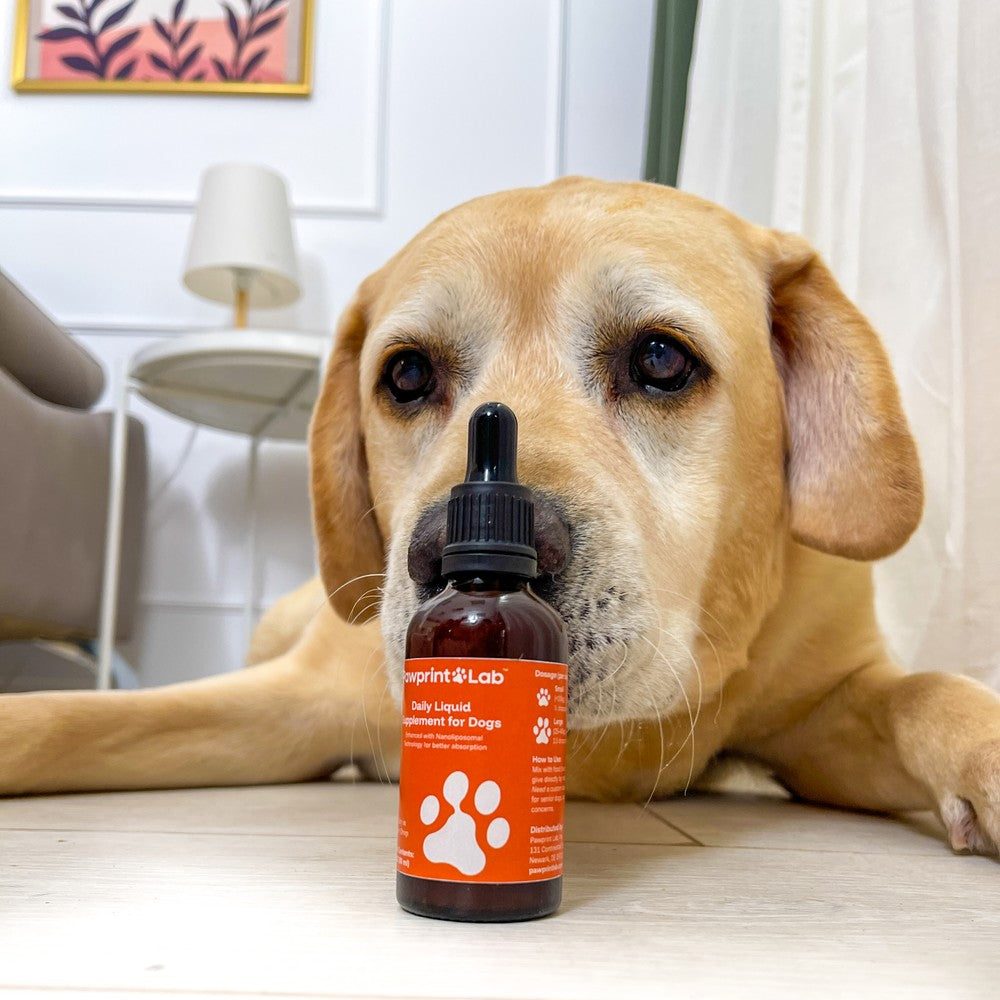
Pawprint Protocol is a liposomal liquid with four named actives: NMN, NAD+, resveratrol and CoQ10.
NMN is a building block in the NAD+ pathway, the raw material cells use to make the NAD+ they spend. Protocol puts NAD+ itself right beside it.
That is job one.
It’s built to be absorbed, not just swallowed. You measure it with the dropper and add it to the food he already eats. No pill pockets. No wrestling him at the counter.
That is job two.
Both jobs. One liquid.
It’s daily cellular energy support for senior dogs. It supports the cellular energy his whole body runs on, starting with the muscles that carry him up those stairs.
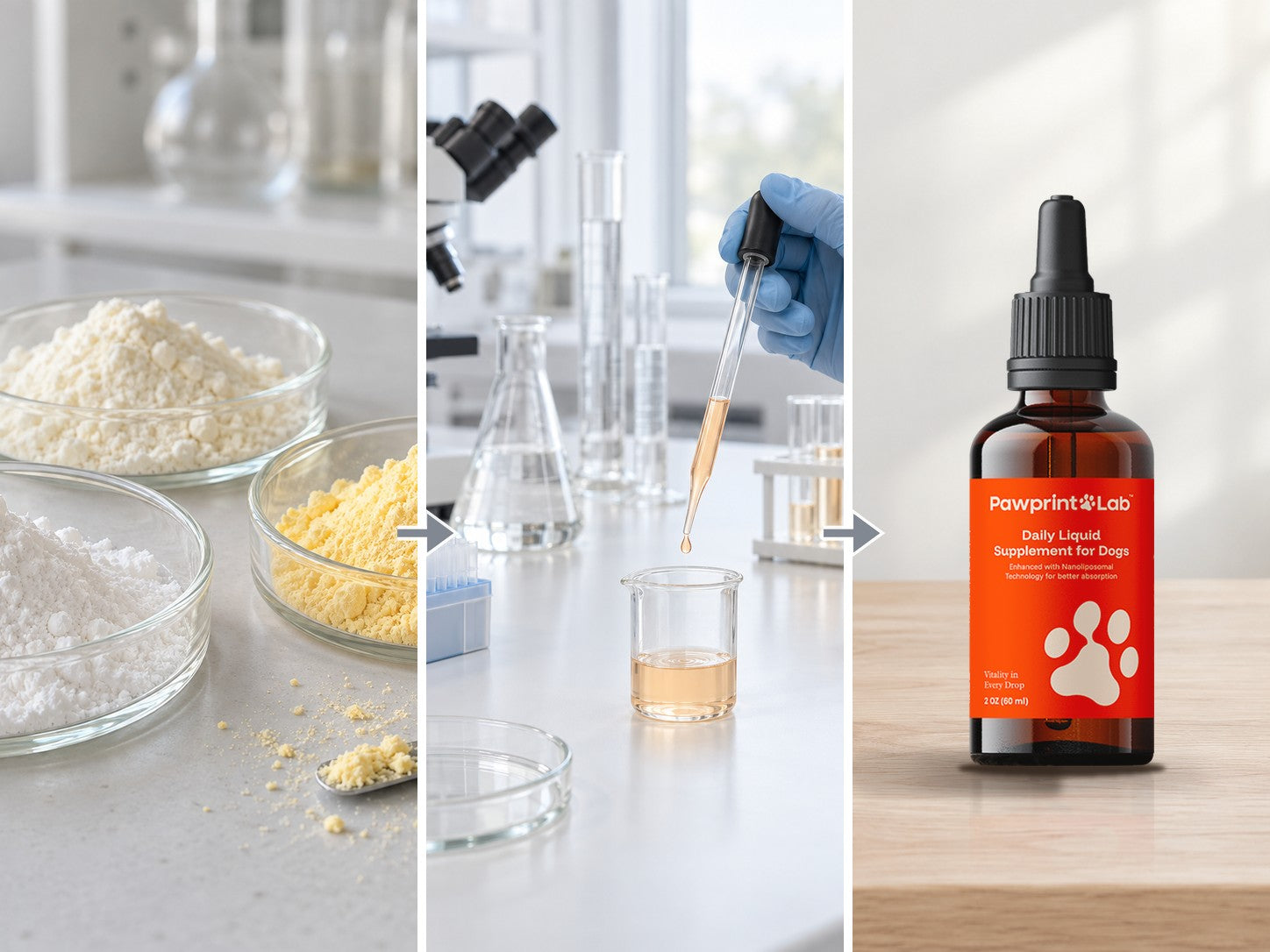
The current Pawprint Protocol label lists four actives:
NMN (nicotinamide mononucleotide). A precursor in the NAD+ pathway, and the formula’s lead active.
NAD+ (nicotinamide adenine dinucleotide). The helper molecule cells spend in everyday jobs like turning food into energy.
Resveratrol. An antioxidant polyphenol studied for its role in cellular signaling.
CoQ10 (coenzyme Q10). Takes part in the cell’s own energy production.
Oral NMN has been given to beagles in a published safety study, and it was well tolerated. That study tested NMN alone, not Pawprint Protocol.
Four actives in one liposomal liquid. One 60 mL bottle with a glass dropper.
| Under 22 lb | 1 dropper a day |
|---|---|
| 22 to 55 lb | 2 droppers a day |
| 55 to 88 lb | 3 droppers a day |
| 88 lb and over | 4 droppers a day |
Mix with food (wet food or kibble works best), or give it directly by mouth. Use daily.
Made in the USA with domestic and imported ingredients. Third-party lab tested.
Pawprint Protocol is a dietary supplement, not a medicine. If he takes medication or has a health condition, ask your vet before adding anything new.
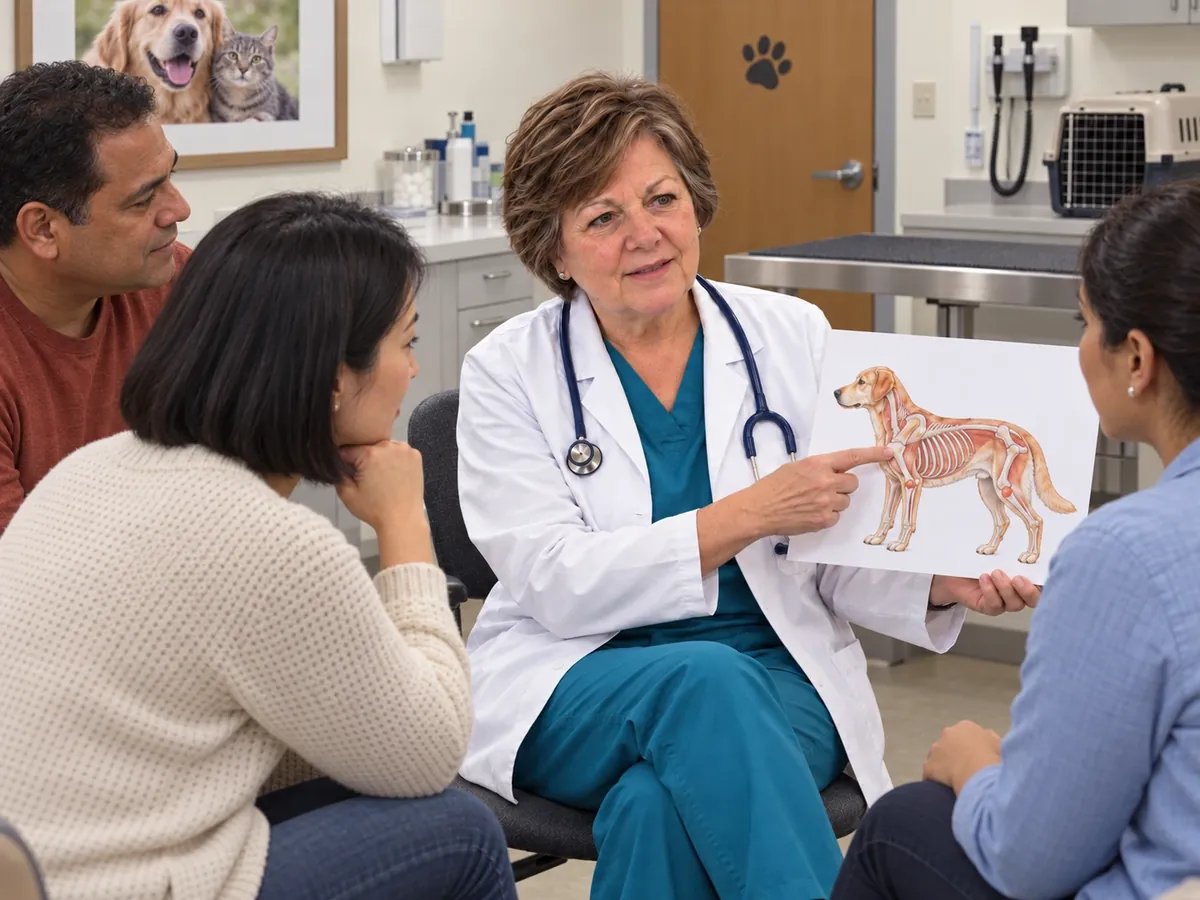
Nobody selling the monthly fix wants you to read this.
The chew makers don’t want you to read this.
The senior-food aisle doesn’t want you to read this.
And the vet I used to be, the one who said “he’s just getting old” and sent you home, would rather you hadn’t found it.
I’m writing it anyway.
Because I was that vet.
I can’t give those years back to the dogs I sent home.
But I can make sure the next person who sits across from a vet like the one I used to be walks in already knowing the right question.
Not “is he just old?”
“What is he running out of, and what can I give him every day?”
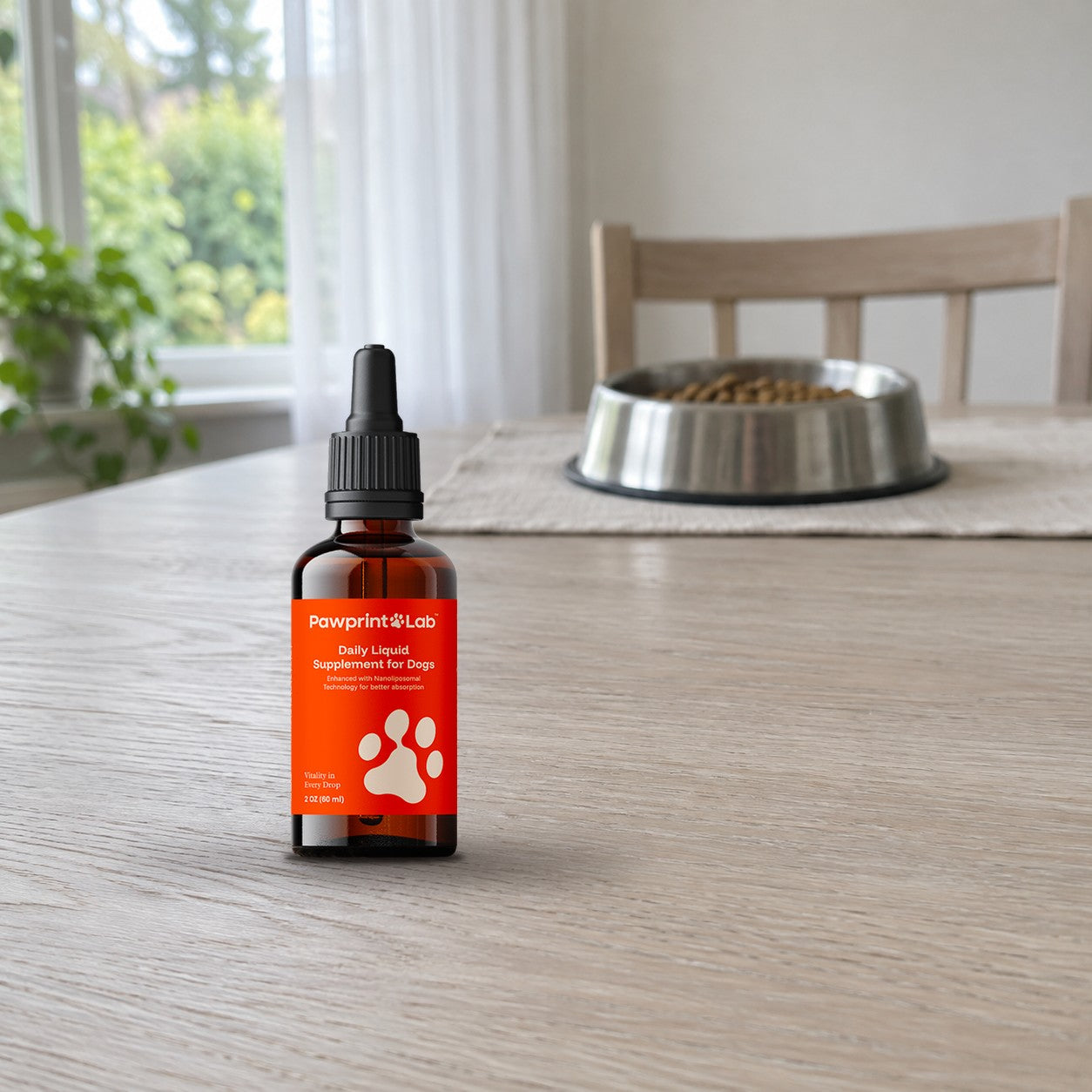
This isn’t overnight. That slide took years. Give the routine time to work.
Yes, this is a daily routine too. The difference is where it aims, and that you get 90 days to find out whether it’s right for him.
The routine settles in. Droppers on breakfast, no pill fight. Keep it consistent, and watch the places you first noticed the slide: the door, the dinner bowl, the stairs.
This is where thousands of Pawprint customers see results. Every dog is different, and there’s no set timetable, which is exactly why the routine matters more than any single day.
This is the fair test. Best results can take three months or more. That’s exactly why the guarantee runs a full 90 days.
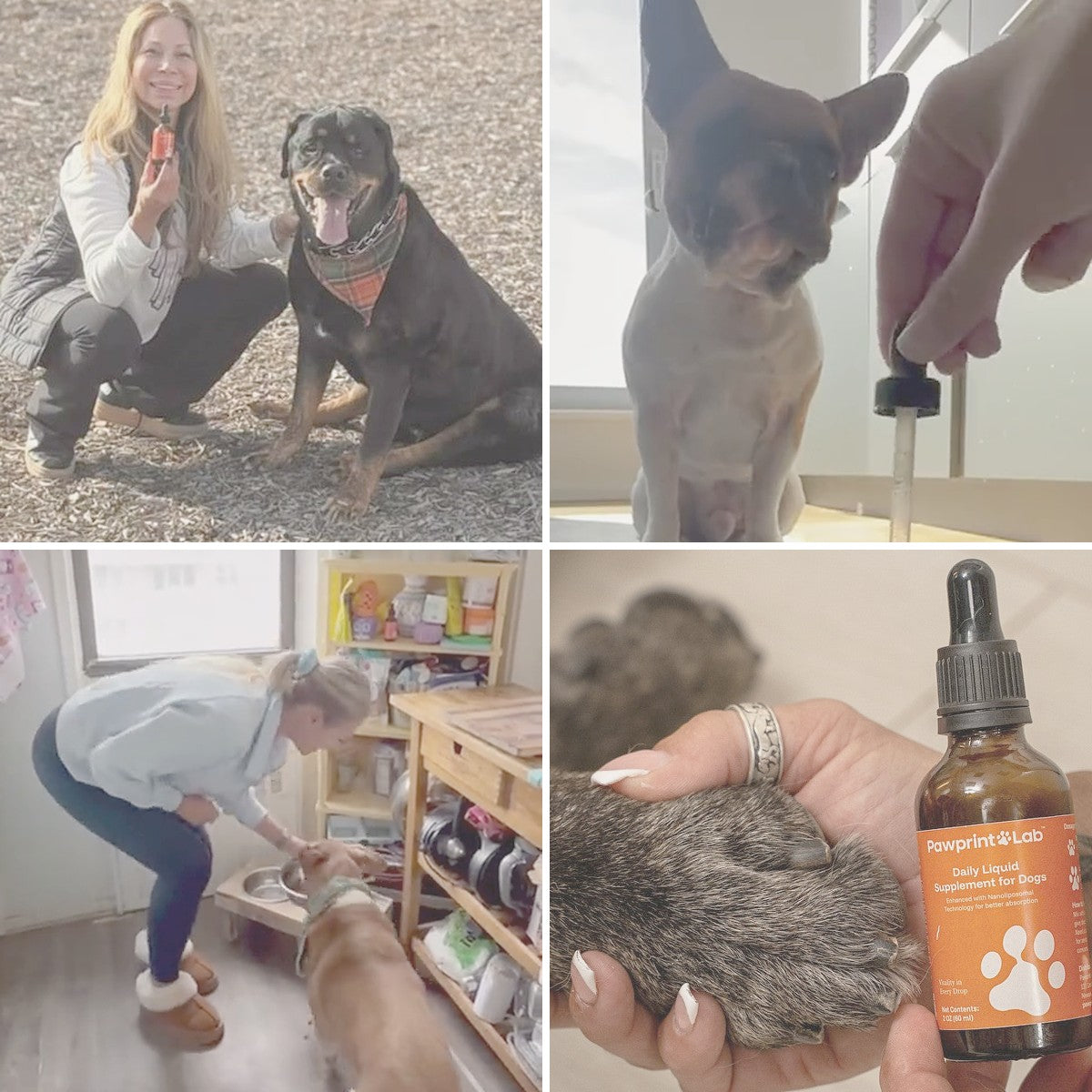
Excerpts from public Trustpilot reviews of Pawprint Lab; cuts are marked with …
Nancy Wells
… Beau is 7 and was already slowing down, having trouble getting up, and gaining weight. … We are headed into month 3 and today he brought me his Frisbee for the first time in over a year and jumped for it. …
Simone H.
I started using Pawprint Liquid supplement for my 11-year-old Mini Schnauzer a little over two months ago, and I’m so glad I did. … Since she’s been taking Pawprint her vitality has returned, and she’s active again. I can truly notice a difference. …
Chris Price
… I know this product helps my 14 yr old dog tremendously. …
After 90 days of use
Pawprint customer survey of 4,857+ owners, after 90 days of use.
94% said their dog had more energy and moved more.
87% saw an improvement in appetite and eating.
84% saw an improvement in mobility.
In 24 years I’ve read a lot of promises on a lot of labels.
Numbers like these, and a refund that almost nobody asks for, tell me more than any of them.
100,000+
Trusted by 100,000+ customers across Pawprint Lab.
<1%
Less than 1% of customers use our Money-Back Guarantee.
4.5
Excellent: 4.5 out of 5 on Trustpilot, from 140 Pawprint Lab reviews (24 Oct 2026).
You’ve been managing this.
The chew. The senior food. The extra nap. The “he’s just getting old.”
And tomorrow morning he’ll stand at the bottom of the stairs and look at you again.
That’s one path. The one the monthly-fix business is built on.
The other path is doing both jobs: refilling what his cells are running low on, every day, in a form built to be absorbed.
More mornings that start at the door instead of on the dog bed. More walks that make it past the corner.
One thing worth knowing before you decide.
The longer the loop runs, the more muscle he has to win back. Every month you wait is another month of less.
Which means the worst thing you can do right now is nothing.
Try Pawprint Protocol with the 90-day money-back guarantee.
Pawprint Protocol. A liposomal liquid in a dropper bottle, on the food he already eats.
No pill fights. No handful of chews.
90-day money-back guarantee. If it isn’t right for him, contact Pawprint within 90 days of delivery. Refund eligibility and terms are in Pawprint’s refund policy.

He’s been waiting at the bottom of those stairs long enough.
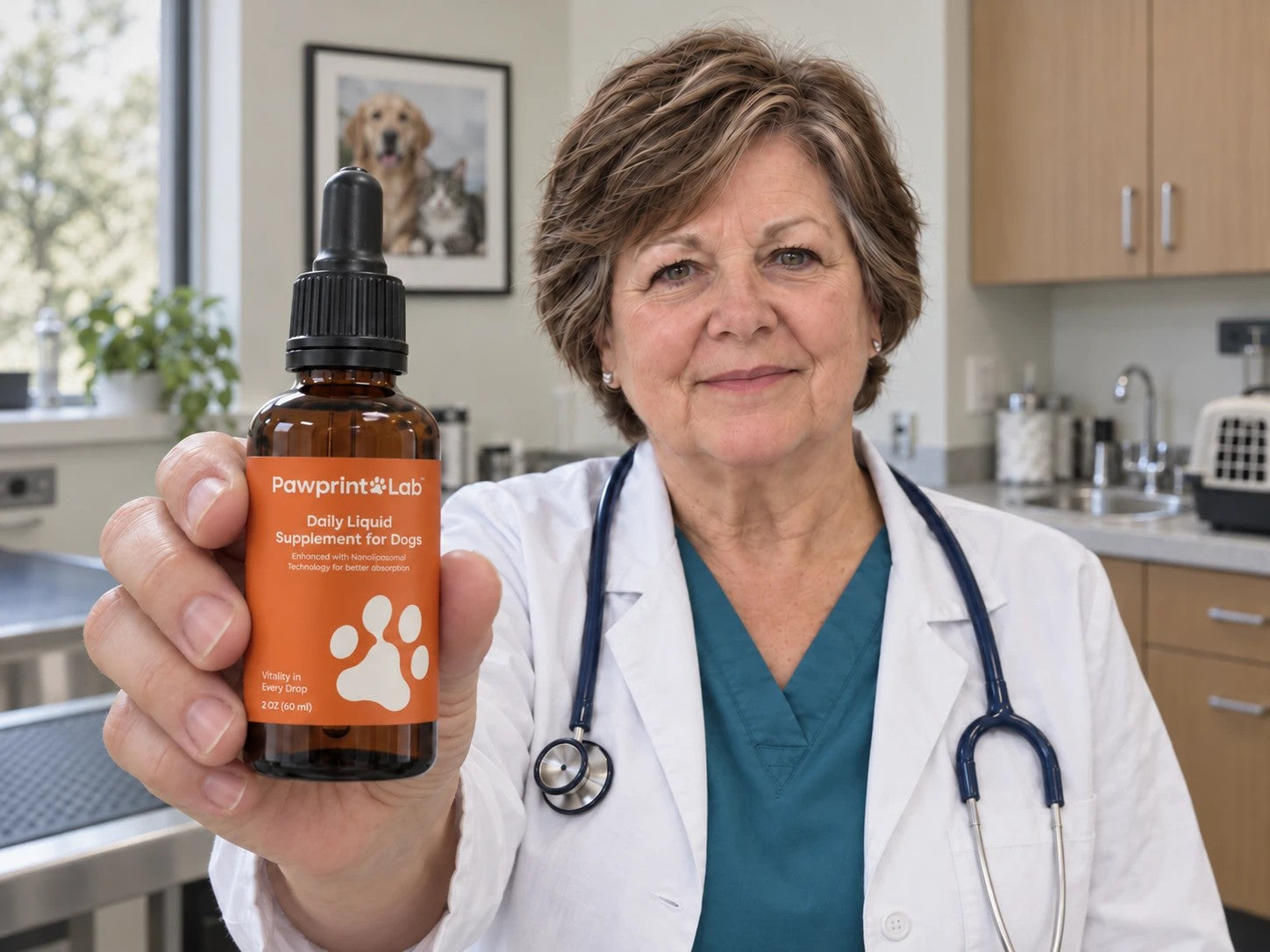
Dr. Evelyn C. Montgomery, DVM
Pawprint Protocol is a dietary supplement, not a medicine.
Current prices and the welcome gifts for 2- and 3-bottle subscriptions are on the product page.