

What the sunlight showed me
You can’t see it. It’s in every home. And he lives closer to it than you do.
Told in the first person by a composite owner, not a real customer. The spore animation is an illustration.
It was a quiet Tuesday afternoon, the hour when the sun comes through the back-bedroom blinds sideways.
Cooper was asleep on his bed by the air vent, where he spends most of his day now. He’s eleven. He sleeps a lot.
The light cut a bright stripe across the room, just above him.
And the air in it was full.
Specks. Hundreds of them. Turning slowly in the light, drifting down toward his face with every breath he took.
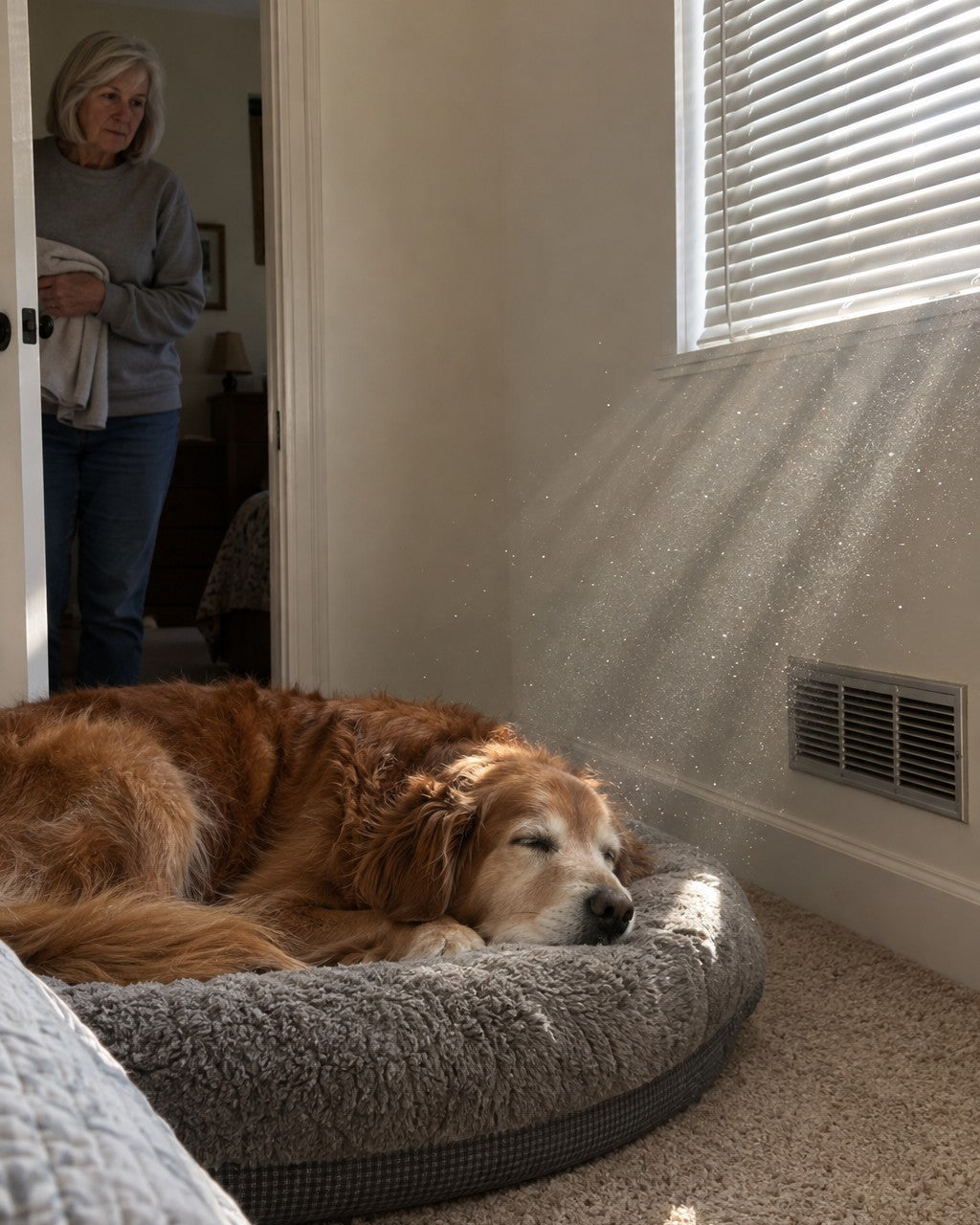
I had vacuumed that room the day before.
That was the part that stopped me in the doorway. The light only showed me the dust. Whatever else was floating in that air, I couldn’t see at all.
And he breathes it all day. On that bed in the afternoon. On the rug by the couch in the evening. Beside my bed at night. Always nose down, a few inches off the floor, where the dust settles and gets stirred back up.
“He can’t choose the air in this house. I chose it for him.”
What the light didn’t show me
I had always thought of mold as something you can see. A black patch in the shower. A spot on a ceiling. Something you find, scrub and forget.
Then I read what the CDC’s workplace-safety institute actually says about it. Molds reproduce by releasing spores into the air, and the spores travel until they land somewhere else. And no indoor space, they write, is completely free of mold spores. Not mine. Not yours.
So the mold I needed to think about wasn’t a patch on a wall. It was in the air, in every room he walks through, far too small to see.
The EPA lists mold spores among the things commonly found in indoor dust, and says that dust gets kicked back up into the air by ordinary life: cleaning, vacuuming, walking, crawling.
Crawling. I thought about Cooper turning his three slow circles before he lies down, a dozen times a day. Nose to the carpet. Face to the vent.
The air inside a house isn’t sealed off, either. Outdoor and indoor air are constantly mixing, the EPA says, and some outdoor air is always coming in, through doors, windows and small cracks.
The CDC is clear that the goal isn’t a home with zero spores. The real question is whether mold is growing somewhere out of sight, and whether there is moisture feeding it.
Ours had both, and I had never looked. A slow leak under the bathroom sink next door. An air conditioner I had never once opened.
Why his nose changes the math
We share our homes with our dogs, and we share our air with them too. They just live lower down in it, nose first, closest to the carpet, the dust and the baseboards.
Not every dog reacts to mold spores. But some dogs are sensitive. In dogs with atopic dermatitis, veterinary dermatology researchers describe an immune response aimed mainly at things in the environment, including dust mites, pollens and mold spores.
In a dog, that kind of reaction most often shows up in the skin. The Merck Veterinary Manual calls itch the characteristic sign of atopic dermatitis in dogs, and lists the paws, face, ears, front legs, armpits and belly as the places most often affected.
I thought about how often Cooper had been licking his paws that winter. I had blamed the salt on the sidewalks. And the crust in the corners of his eyes in the mornings, which I had wiped away without a second thought.
I want to be careful here, because I wasn’t careful then. None of this told me that mold was behind his paws or his eyes. Itch has a long list of possible causes, and a vet diagnoses atopy by ruling the others out, not with a single test. Specks in a sunbeam are not a diagnosis. Neither is a photo of a dog.
If your dog is coughing, wheezing, breathing hard, or scratching and licking more than usual, that’s a conversation for your veterinarian, however clean your house looks.
In their own words
These are short excerpts from one public thread on a dog-allergy forum, quoted as written. The people in it are not Pawprint customers, and nobody in it is talking about Pawprint.
…if their pets had similar symptoms especially with mold in the air.
We put our AC units in recently and saw the insides covered in mold…
Different houses. The same question, asked at the same kind of kitchen table, late at night.
The part that happens inside
The leak and the air conditioner were house problems. I could call someone about a house problem.
What I couldn’t stop thinking about was the other half: what a sensitive body actually does when it keeps meeting something it reacts to.
Here is the plain version. When the immune system reacts, some of its cells produce reactive oxygen molecules as part of the response. That’s normal; it’s one of the tools they use. At the same time, every cell keeps those molecules in check with its own antioxidant systems. Biologists call it redox balance. When the oxidants get ahead of the antioxidants, that is what they mean by oxidative stress.
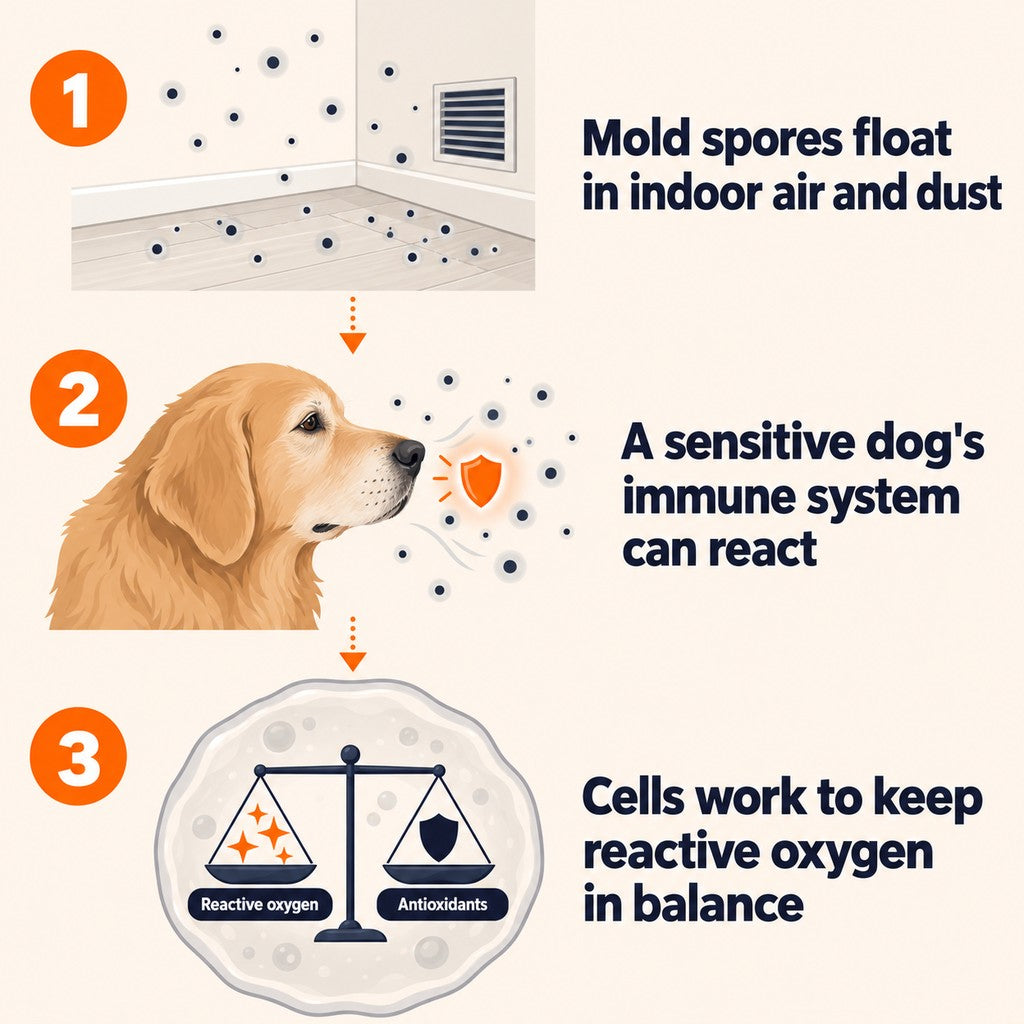
Then I found a study that made the question impossible to put down.
Researchers in South Korea studied 73 companion dogs: 44 with atopic dermatitis and 29 healthy dogs. They measured the air inside each home and tested the house dust. Among the dogs with atopic dermatitis, 26 lived in homes where the owners reported visible mold on the walls, and 18 did not.
The dogs from the homes with visible mold had more severe skin signs. Their homes had more of the coarse airborne particles called PM10. And their blood showed higher levels of two markers: IgE, a sign of allergic immune activity, and reactive oxygen metabolites, a sign of oxidative stress.
It was small, observational and from one country. Mold was reported by owners on a questionnaire, not measured on the walls, and PM10 counts airborne particles of every kind, not spores.
The researchers also measured a mold toxin, aflatoxin B1, in the household dust, and it was central to their own analysis. The study shows an association, not a cause. It did not measure what any dog breathed in, and it did not test any supplement.
Source: Oh S, Han J, Kim HJ. Indoor Mycotoxin Exposure on Atopic Dermatitis in Companion Dogs. Allergy, 2025.
That study didn’t tell me what had happened inside Cooper. Nothing could, from the outside. But it showed me why the question shouldn’t end at what I could see.
The part I could fix
So I started with the house, in the order the experts put it.
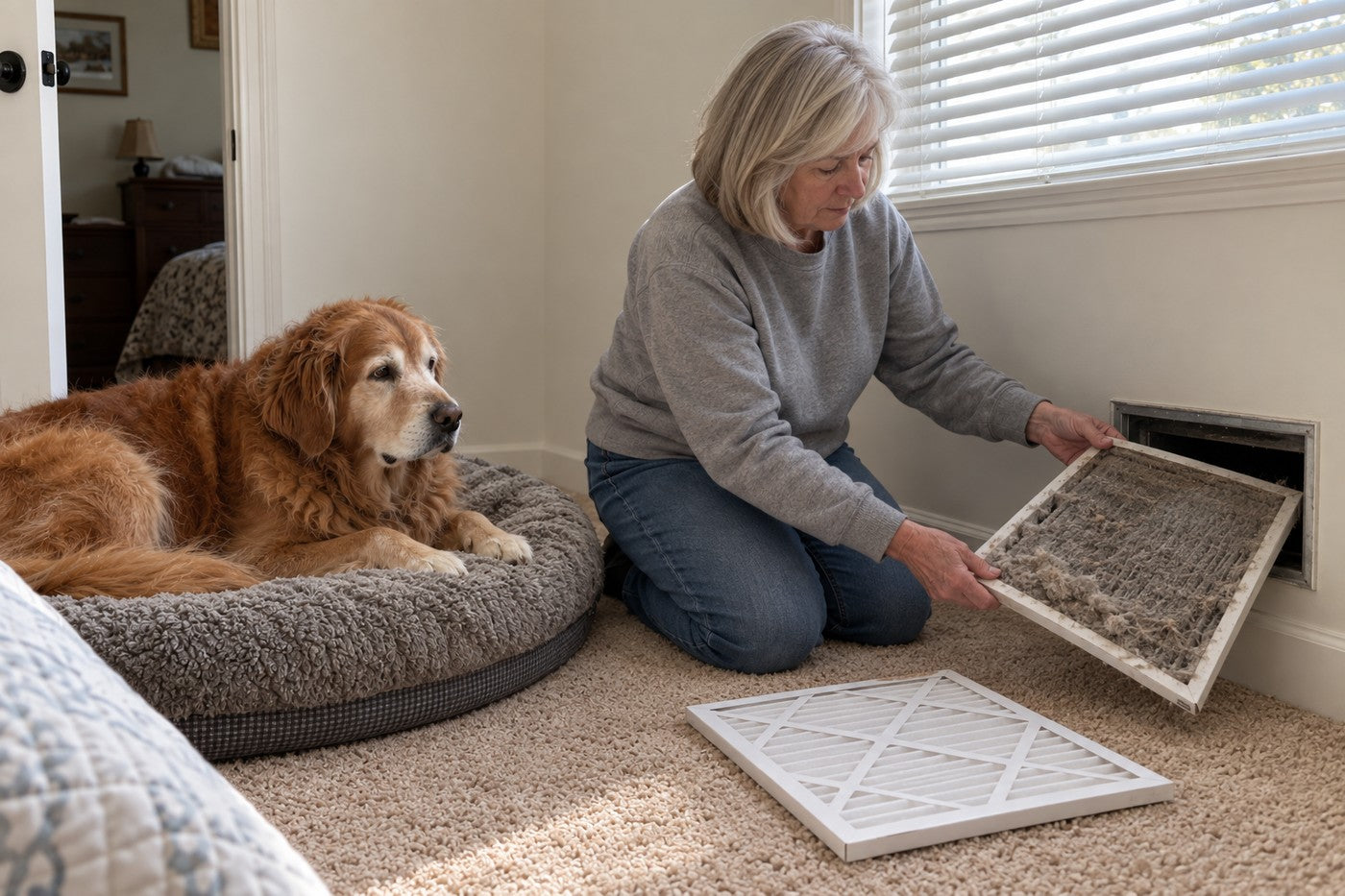
At his appointment, I told his vet everything, including the air.
All of that was the house, and all of it was the right thing to do.
But I kept circling back to one thought. I couldn’t go back and un-breathe the air he had already breathed. The air was cleaner now. The three winters he had spent breathing the old air weren’t coming back.
What I could still choose was whether his daily care had any real thought behind it.
“I had spent three winters not knowing what was in his air. I wasn’t going to keep guessing about what was going on inside him.”
That’s what sent me looking at cellular care. Not instead of cleaning up the air. A separate, deliberate part of caring for the dog who breathes it.
What I went looking for
I didn’t want another bottle that promised to make him “healthier.” I had had enough of vague. I wanted to understand the biology, three pieces of the same inside-the-body story: how his cells make energy, how the tiny power plants inside them run, and how cells handle everyday stress.
NAD+ is a helper molecule cells spend on everyday jobs, like turning food into energy. NMN is a building block cells use to make NAD+.
CoQ10 sits in the membranes of mitochondria, the parts of the cell that make energy. Researchers describe it as playing a major role in energy production and in antioxidant defense.
Resveratrol is a plant polyphenol, the kind found in grape skins, that scientists study for how it affects the way cells handle stress.
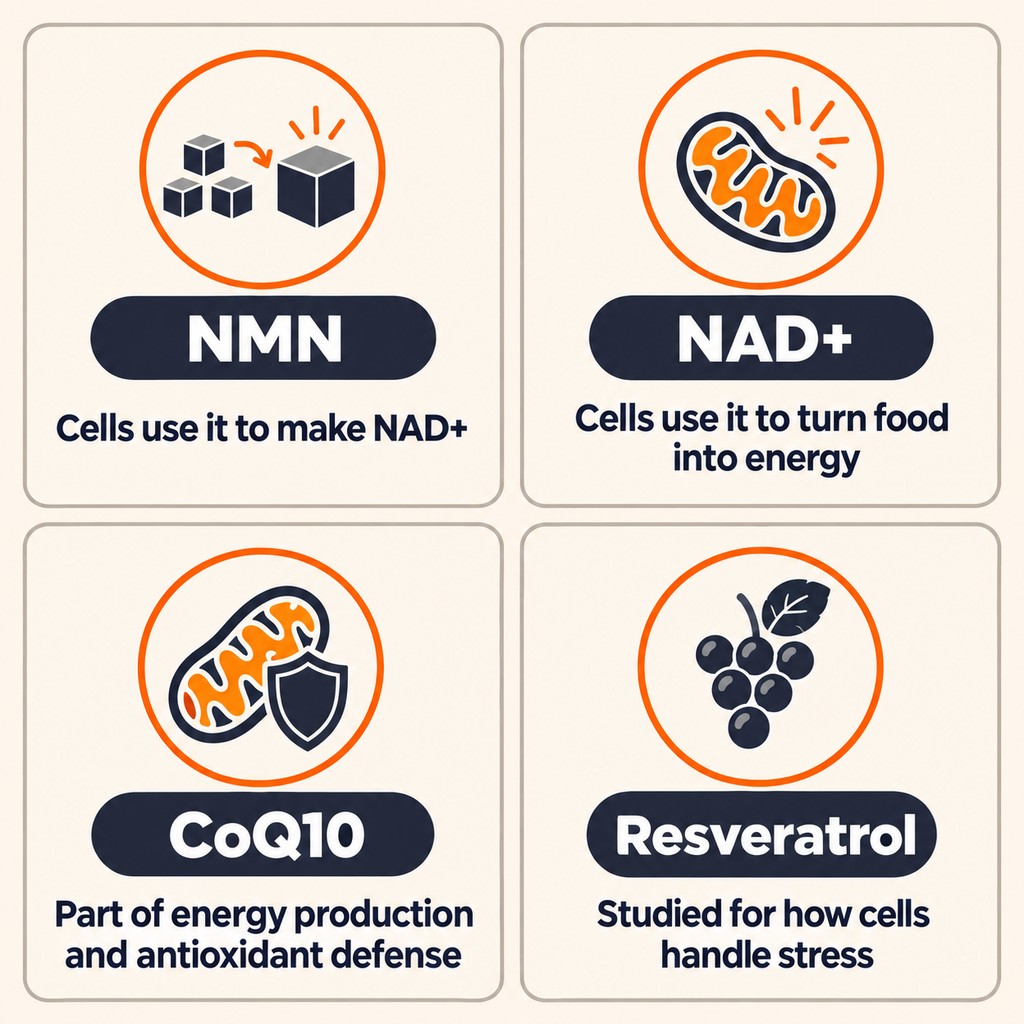
For the first time, caring for his inside felt specific. I wasn’t looking for a promise anymore. I was looking at the biology a formula could actually be built around.
The daily formula I chose
Pawprint Protocol put all four of those ingredients, NMN, NAD+, CoQ10 and resveratrol, into one liquid that goes on his food. It’s liposomal, designed for absorption.
The first bottle got a thorough sniff, which for an old retriever is most of the battle. Weight sets the dose: at 70 pounds, Cooper is in the large band, three droppers a day on his breakfast.
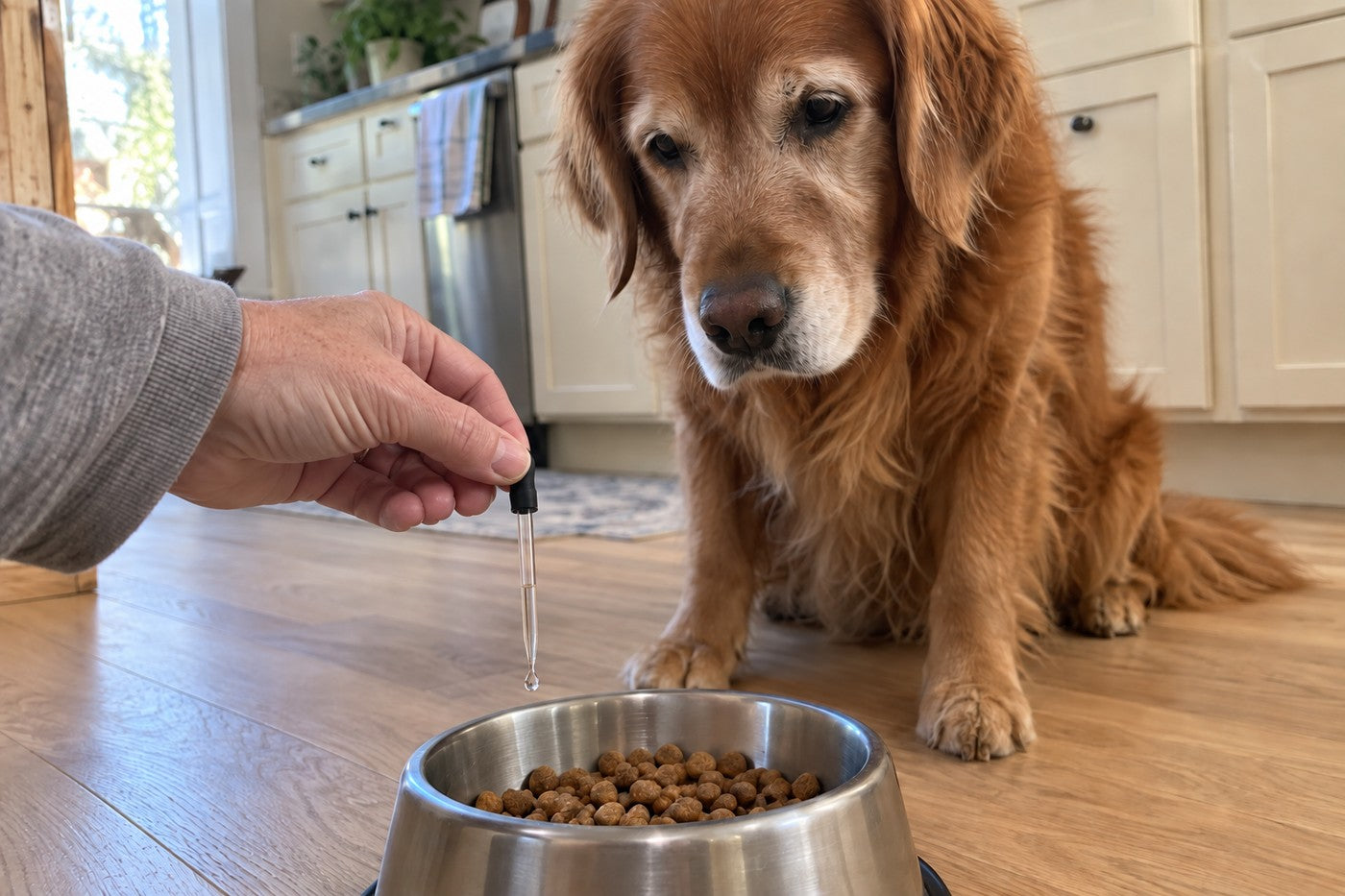
The air got its own fix: the leak, the air conditioner, the filter humming by his bed. Cooper got his: one small, deliberate thing for the inside of him, every morning, in the bowl he already loves.
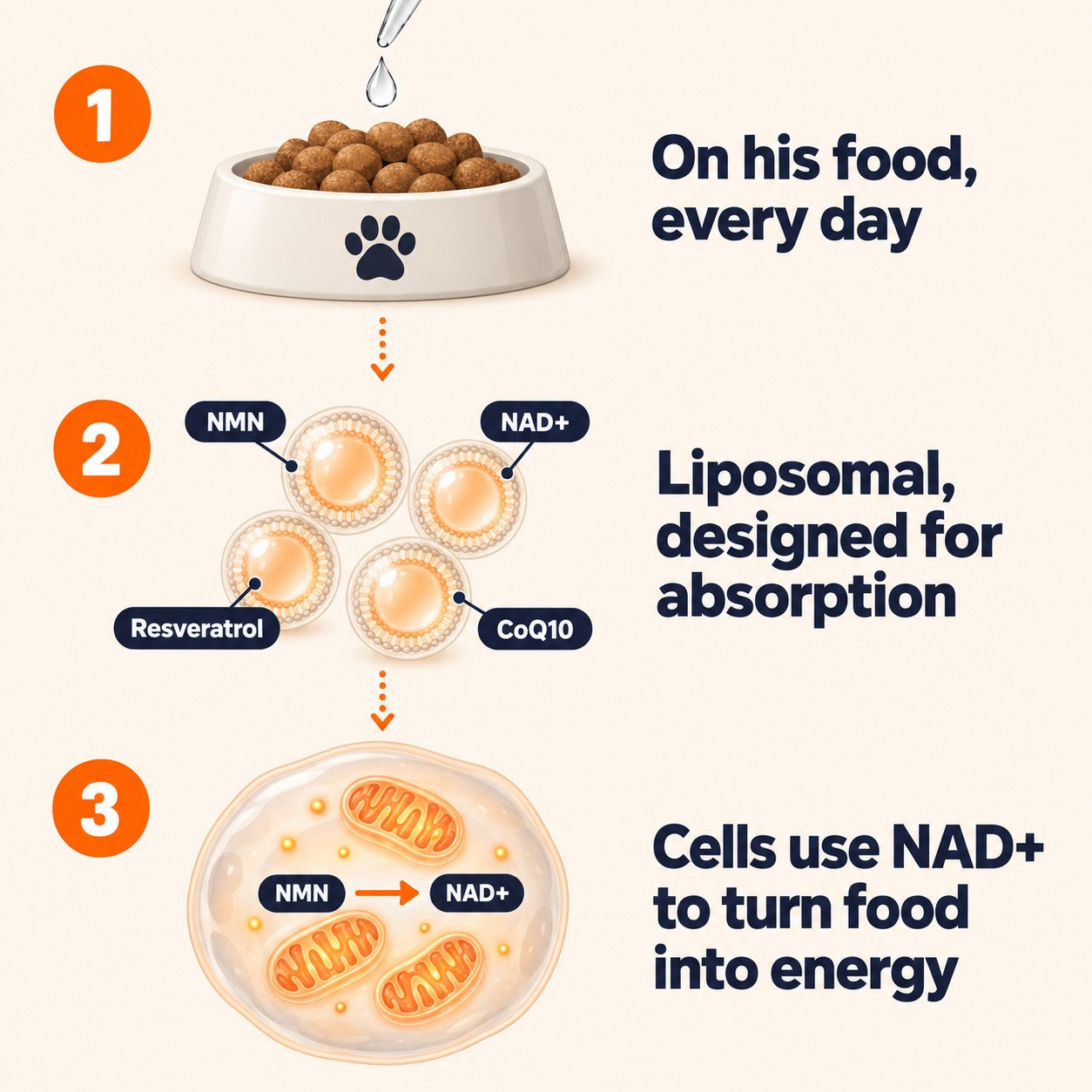
In his cells, NMN is the building block for NAD+, the molecule they spend turning food into energy. CoQ10 and resveratrol ride along in the same dropper.
Two different jobs, and now both of them get done on purpose.
What the air didn’t take
He still turns his three slow circles before he lies down. He just does them in the middle of the room now, away from the vent, beside a filter that hums all day, in the patch of sun from the window I keep cracked open.
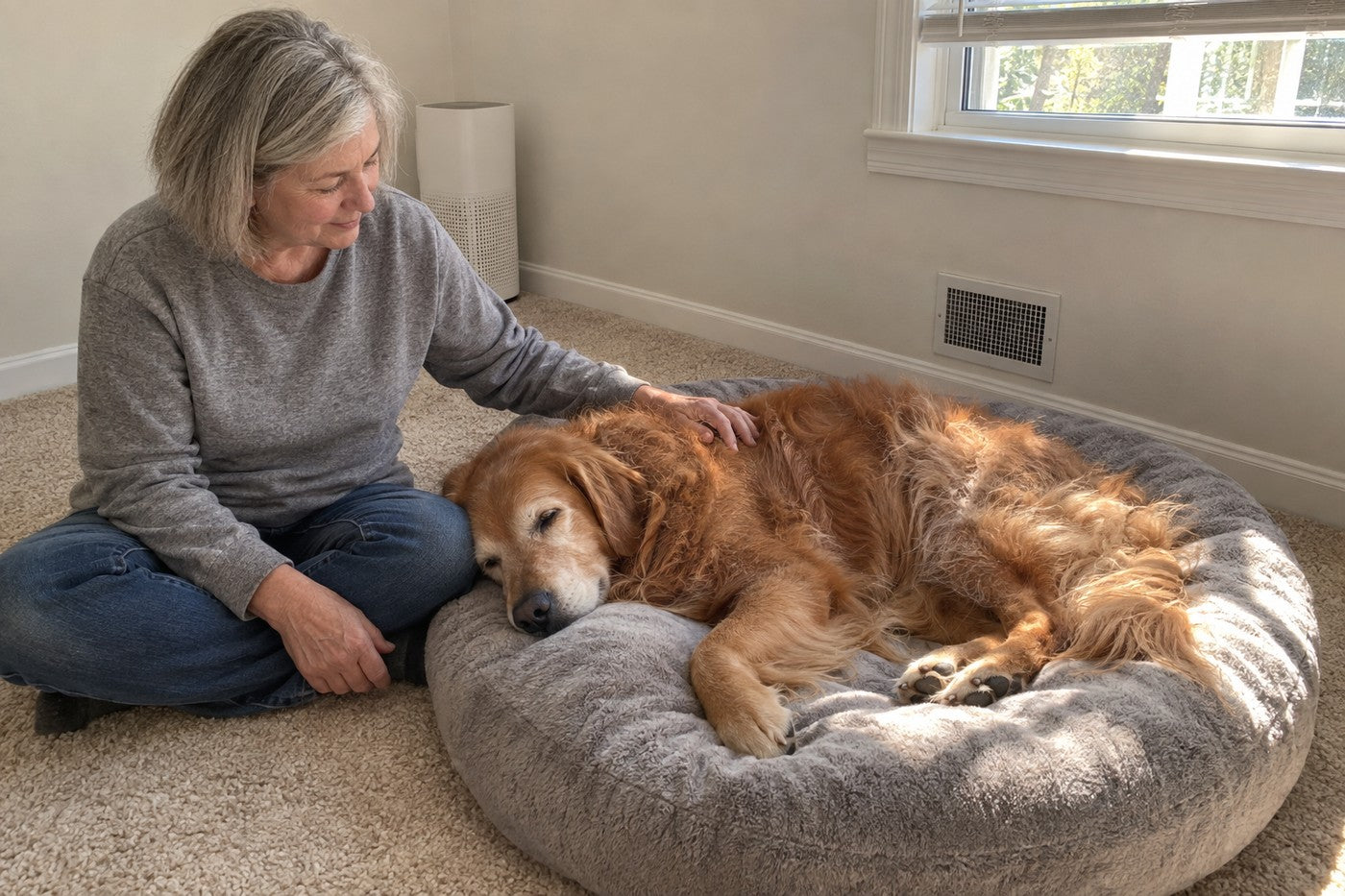
He still thumps his tail on the floor when I say his name. He’s eleven. He’s allowed to be slower. He is not allowed to be something I forgot to think about.
He can’t choose the air he breathes. That’s exactly why I choose so carefully now.
Where Pawprint Protocol fits
Pawprint Protocol is a daily liquid for senior dogs. It goes on the food he already eats, once a day, and his weight sets the droppers.
Inside are four named actives, NMN, NAD+, resveratrol and CoQ10, in a liposomal liquid designed for absorption. Its job is daily cellular energy support: the whole dog, every day, while the air in the house gets its own attention.
Public sources behind the facts on this page. None of them studied Pawprint Protocol.


