

A quiet morning, written down
The first lift after a long rest is often the hardest ten seconds of an old dog’s day, and the one moment most owners never say out loud. Here is what to watch, what to write down for your vet, and when it’s a visit, not a wait.

It’s early.
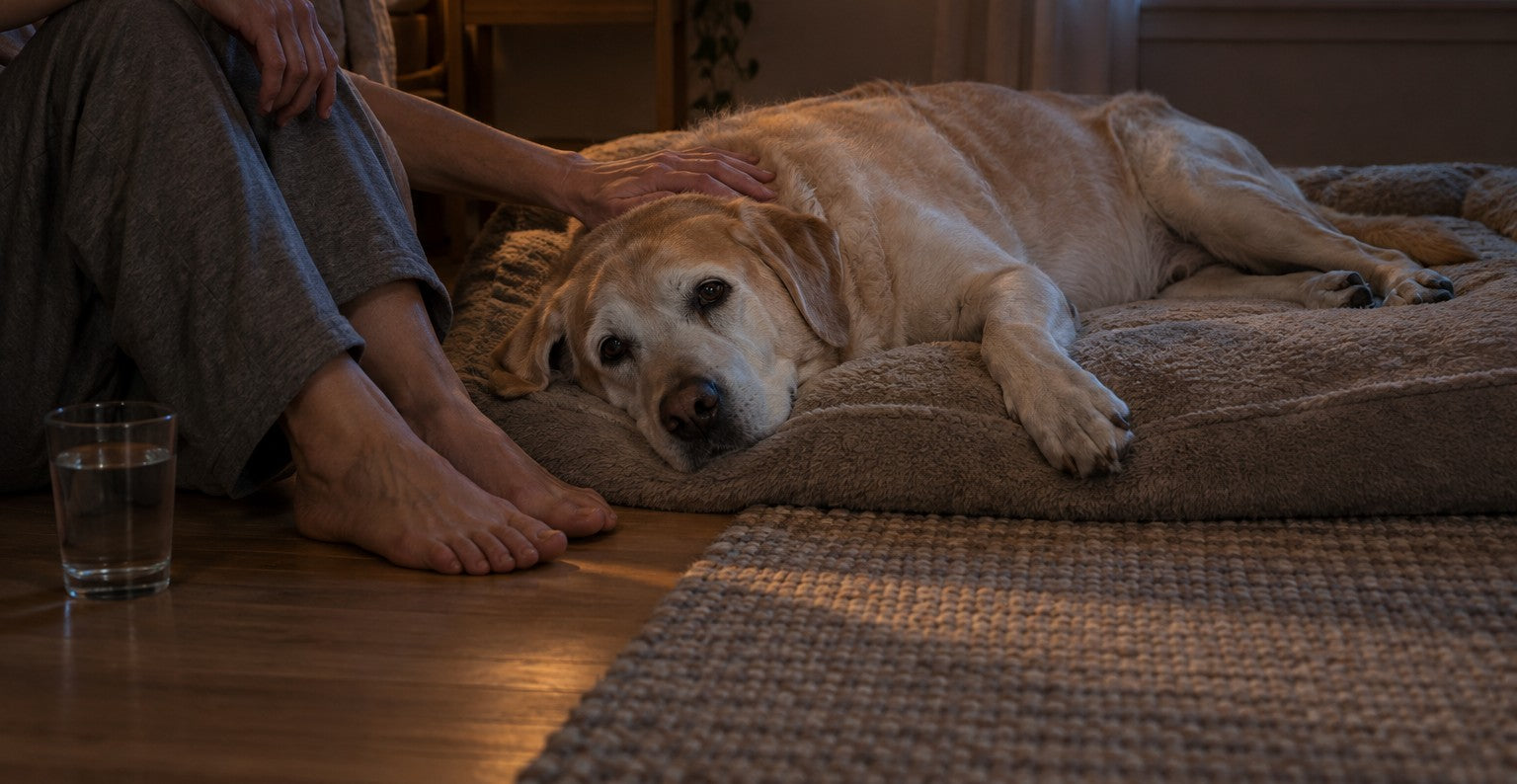
He’s been down for eight hours, maybe nine, on the bed at the foot of yours.
You hear the sigh first. Then the shift.
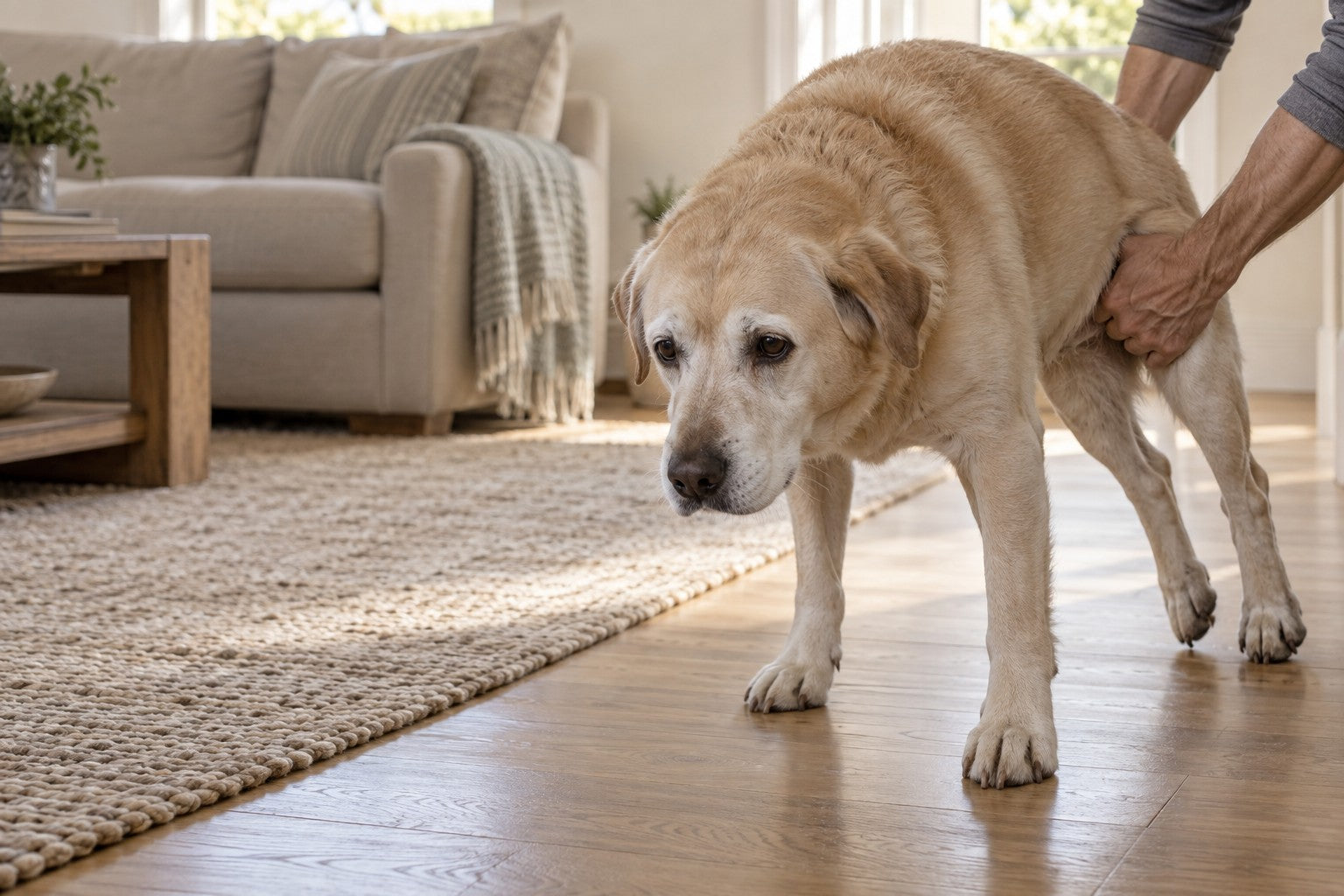
The front half comes up the way it always has. Head, shoulders, one paw planted.
And then the back half doesn’t follow.
Not right away.
He stops there, half up, and does the thing you weren’t ready for the first time it happened.
He looks back at you.
Not at the door. Not at the window. At you.
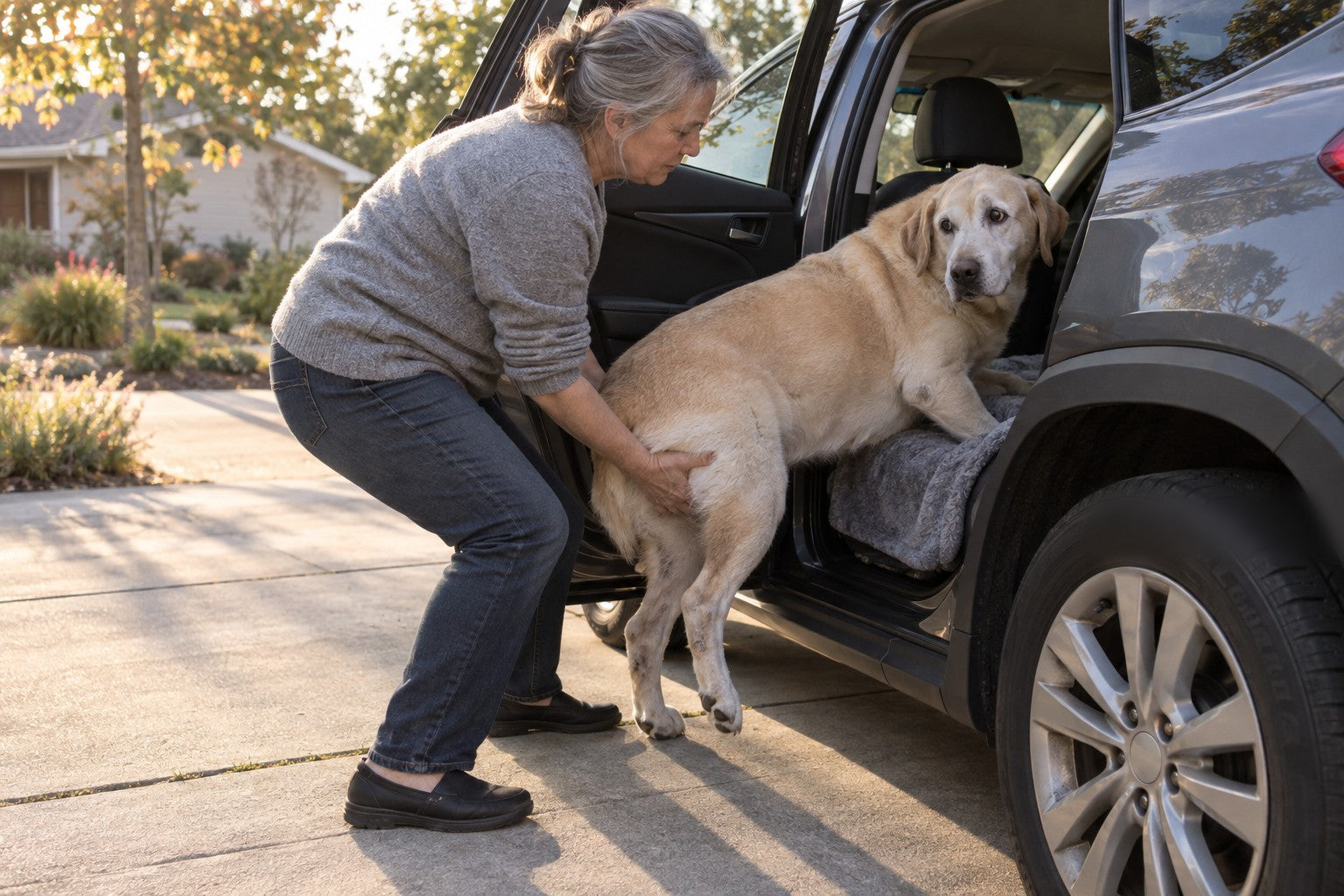
Your hands are already out. They’ve been out since the sigh. They stop an inch above his hips and stay there, because you don’t know what to do with them.
Help him, and you might hurt him.
Don’t help him, and you’re standing there watching him ask.
And underneath both of those, a quieter worry you don’t say to anyone: that this is the first morning of something, and you won’t know which morning it was until later.
If you have ever thought this sentence, this page was written for you:
“He looks at me to help. I’m afraid I’ll hurt him.”
The part nobody warns you about
Nobody tells you the memory arrives at the same time as the moment.
You’re watching him gather himself at the edge of the bed, and somewhere behind your eyes he’s three years old and already at the door, already turning circles, already impatient that you’re still in your socks.
He used to beat you to the morning.
Now the morning has to loosen before he can get into it.
Nothing about the room changed. The bed is the same bed. The floor is the same floor. The distance to the door hasn’t moved an inch.
He did.
And the part that sits in your chest all day isn’t the slowness. You could live with slow. Slow is still him.
It’s that he asked.
He has never had to ask you for anything. Not for the walk, not for the door, not for the last bite of whatever you were eating. He took, or he waited, or he made you laugh until you gave in. He never once looked back to see if you were coming.
Now he does. Every morning. And every morning you understand a little more clearly that the two of you have quietly traded places. You used to wait for him at the door. Now you wait for him at the bed.
What you can know, and what you can’t
Here’s what you can say for certain about the look back: he’s checking that you’re there.
Here’s what you can’t say: why the back half is slower to follow the front.
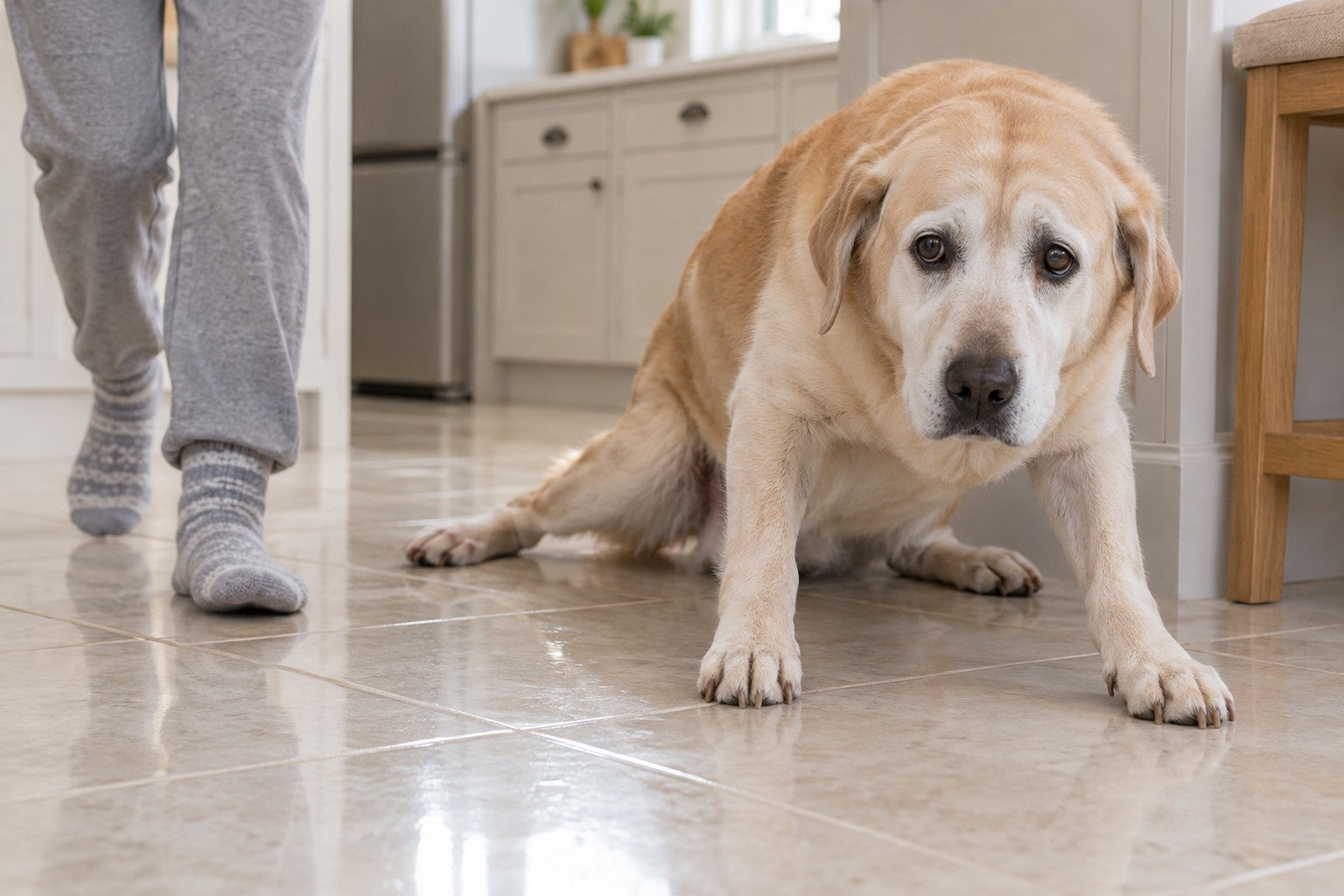
That isn’t a failure of attention on your part. It’s the honest limit of what anyone can know from the outside of a dog. A slow first rise after a long rest can come from more than one place: the joints, the muscles, the nerves, plain discomfort, or something as ordinary as a cold night on a hard floor. From where you’re standing, every one of those looks the same. It looks like a dog who stopped halfway.
Owners don’t talk about this moment much. Partly because it’s private. Partly because saying it out loud makes it real. And partly because when your hands are hovering, the question in your head isn’t a vet question yet. It’s just: what do I do right now.
So here is the reframe that changes the morning, even on the mornings it doesn’t change him:
The first lift isn’t a chore you quietly took on. It’s the most useful piece of information you have about him, and almost nobody writes it down.
Your hands
There is a right way to help a dog up. It depends on his size, on where the slowness actually is, on what he’ll tolerate, and on your own back.
Which is exactly why you shouldn’t learn it from a stranger’s article. Including this one.
A veterinarian, or a canine rehabilitation professional, can watch him do the real thing and then show you, with your hands on your dog, how to help if he needs it. It’s a five-minute conversation. It’s also the whole difference between helping and hurting, and you already know that. It’s why your hands stop an inch above him every morning.
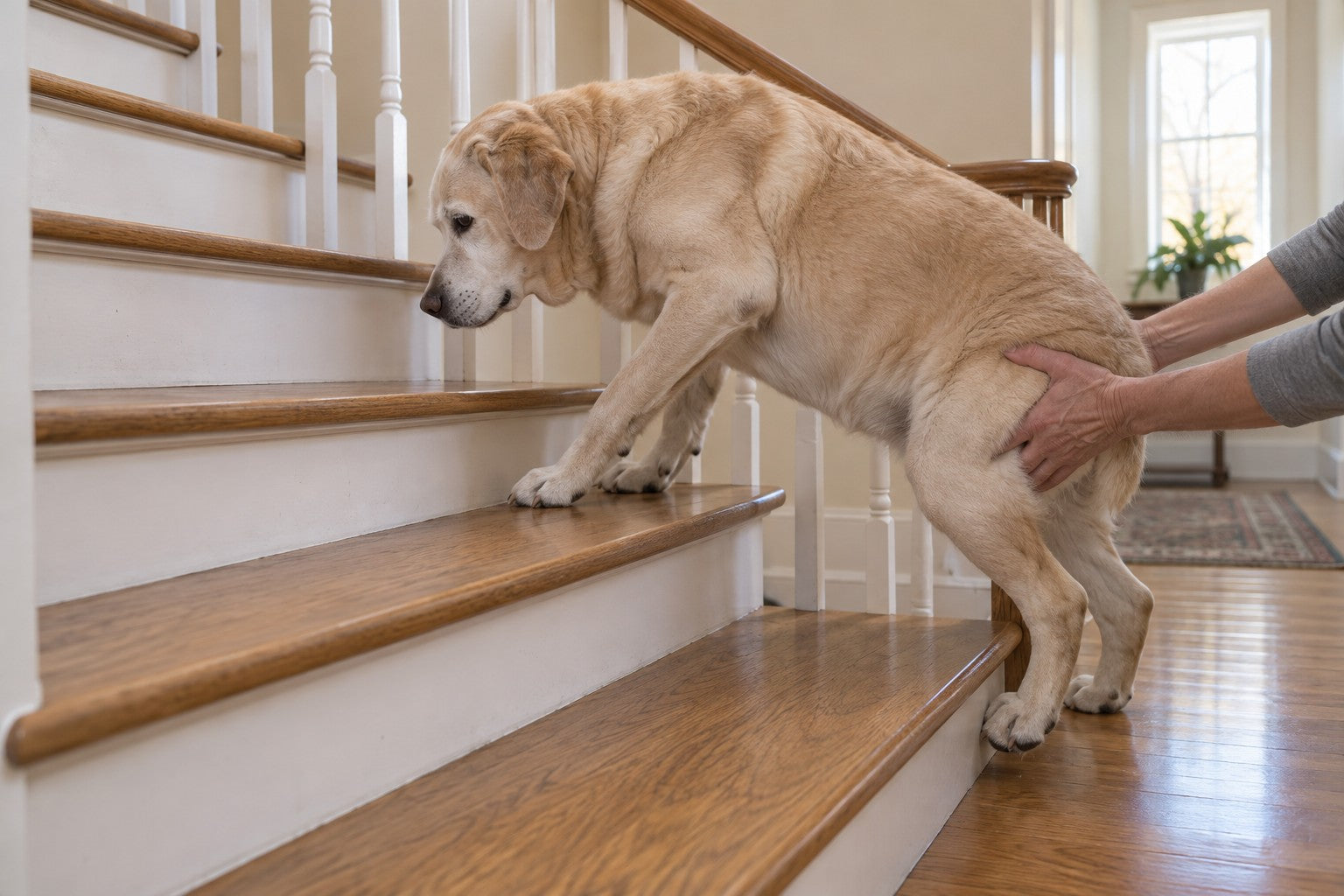
Until someone has shown you, the honest place for your hands is where they already are. Close. Steady. Ready. Not pulling.
Give him the second he’s asking for. If he finishes the job himself, let him, and watch the first few steps. They will tell you more than any amount of lifting would. If he can’t finish it, that isn’t a technique problem. That’s the list a little further down this page.
What to write down

Nobody expects you to know why. What you can do, and what only you can do, is describe it.
You’re the only person on earth who sees his first lift every day. Your vet sees him for fifteen minutes, in a room he’s nervous in, on a floor he doesn’t know, after a car ride that woke everything up. By the time he’s on the exam table, the morning is gone.
So bring it with you. For one week, write these down in plain words, the way you’d tell a friend. No interpreting. Just what happened.
One more thing, and it may be the most useful of all: a twenty-second phone video of an ordinary morning lift, taken from the side. Don’t stage it. Don’t ask him to do it twice. Just film the one that was going to happen anyway.
None of these seven tells you why. That’s the point. You aren’t building a diagnosis. You’re building the thing your veterinarian needs to make one.
When it isn’t a wait
Not every slow morning is a normal part of getting older. Some are medical problems that look almost the same from the outside, and they need a vet, not a notebook and not a supplement.
If any of these show up, that’s a vet visit today, not a week of notes:
You know him better than anyone in that building will. If your gut says get him seen, get him seen. That isn’t overreacting. That’s the job.
In their own words
Owners don’t post about this much. When they do, it reads like this. These are short excerpts from public dog forums, quoted as written. They are not Pawprint customers, and nobody in them is talking about a product.
Every now and then my 17 year old dog has trouble getting up out of her bed.
When she lays down for too long on a hard surface she stands up stiff and has a limp for a short bit.
My old guy (13 y/o lab mix) has been slowing down a lot lately. He’s still happy and loves short walks, but the mornings are getting tough stiff legs, taking a while to get up and sometimes he hesitates with stairs.
Different dogs. Different houses. The same first ten seconds. And the same person standing there with their hands out.
What the look doesn’t take
Here’s the thing the look back doesn’t take away.
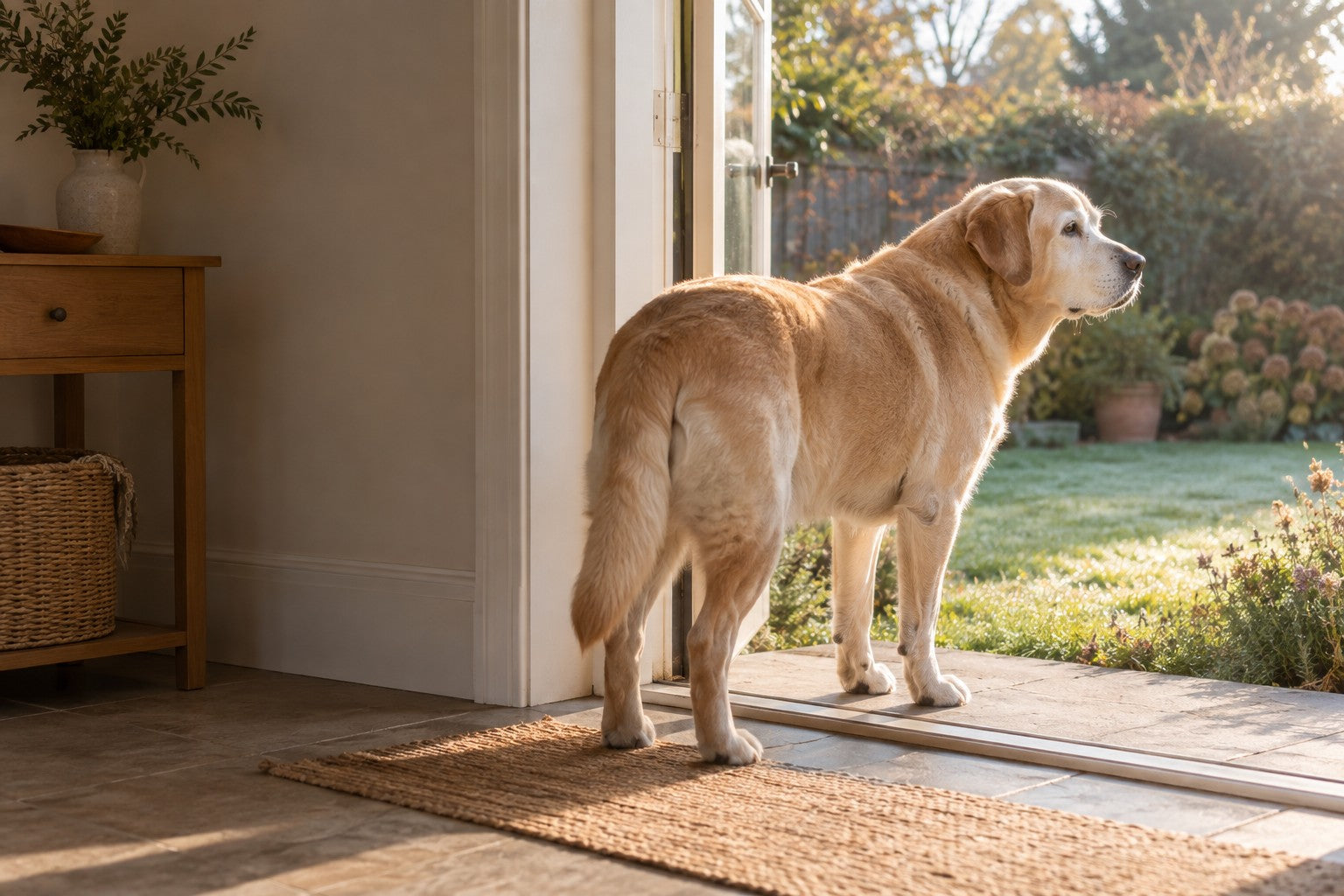
The tail still goes when you say his name. He still wants the walk, even if it’s the short one now. He still follows you room to room, just a few seconds behind.
He isn’t sad about his mornings. You are. He’s working with the body he has, and the person he trusts most is standing right there, which, as far as he’s concerned, is the whole situation handled.
You’re doing more of the work than you used to. That isn’t a failure of anything. That’s what it looks like to love an old dog on purpose.
And if you already tried something for him and the mornings didn’t change, that wasn’t a mistake either. That was you, trying. Trying is allowed to come before knowing.
This week
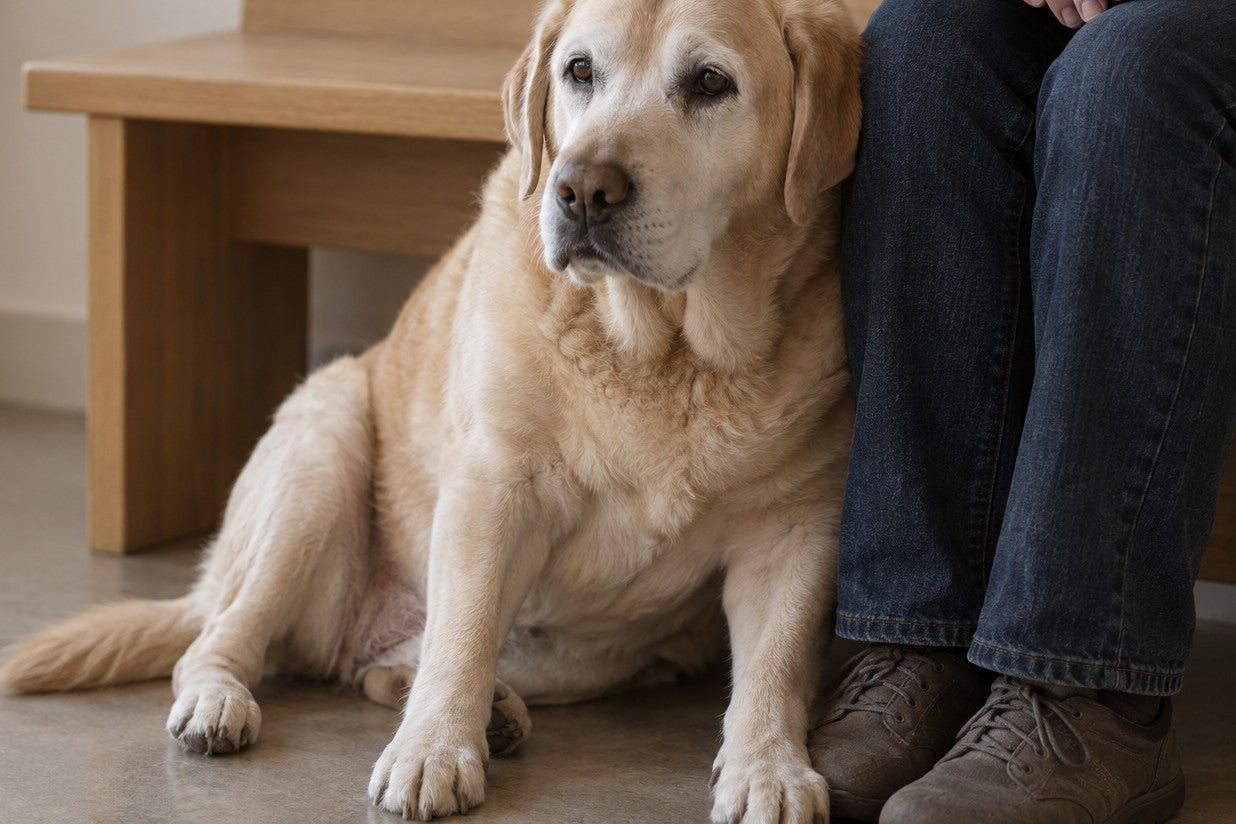
He looked back at you because you’re the one he trusts. Be the one who wrote it down.
Where Pawprint Protocol fits
It’s on this page for one reason: the morning that holds the first lift also holds his breakfast bowl.
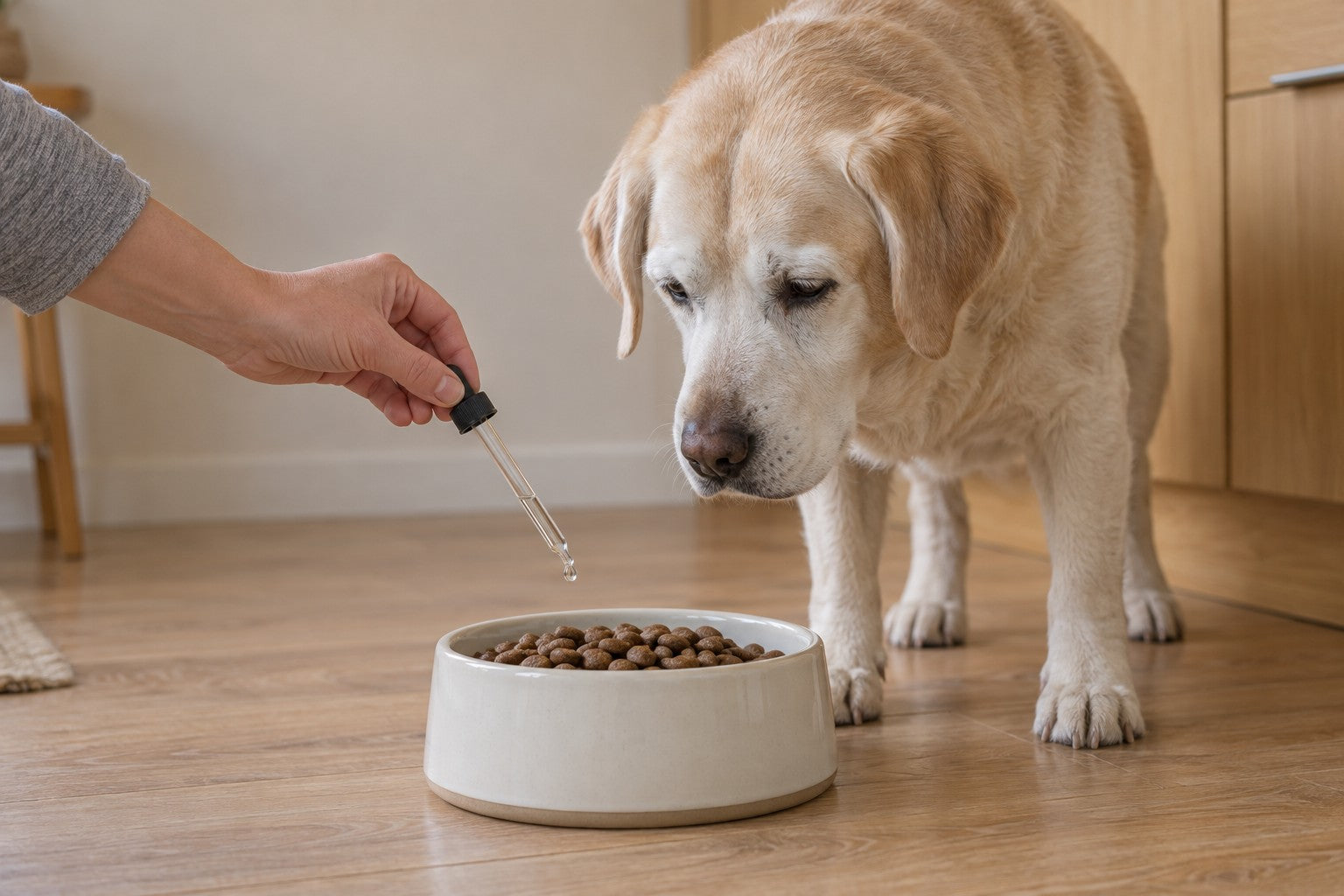
Pawprint Protocol is a daily liquid for senior dogs. One dropper on his food, once a day, in the same bowl he already knows. It’s a liposomal liquid, built to be absorbed, not just swallowed, so more of what’s in the dropper actually reaches the cell.
Inside are four named actives: NMN, NAD+, resveratrol and CoQ10. NMN is the direct building block cells use to make NAD+. NAD+ is the helper molecule cells spend on everyday jobs, such as turning food into energy.
Its job is daily cellular energy support for a senior dog. The whole dog, every day, in the ordinary part of his morning that never asks anything of either of you. You keep doing the part only you can do: watching the first lift, writing it down, and bringing it to someone who can examine him.


