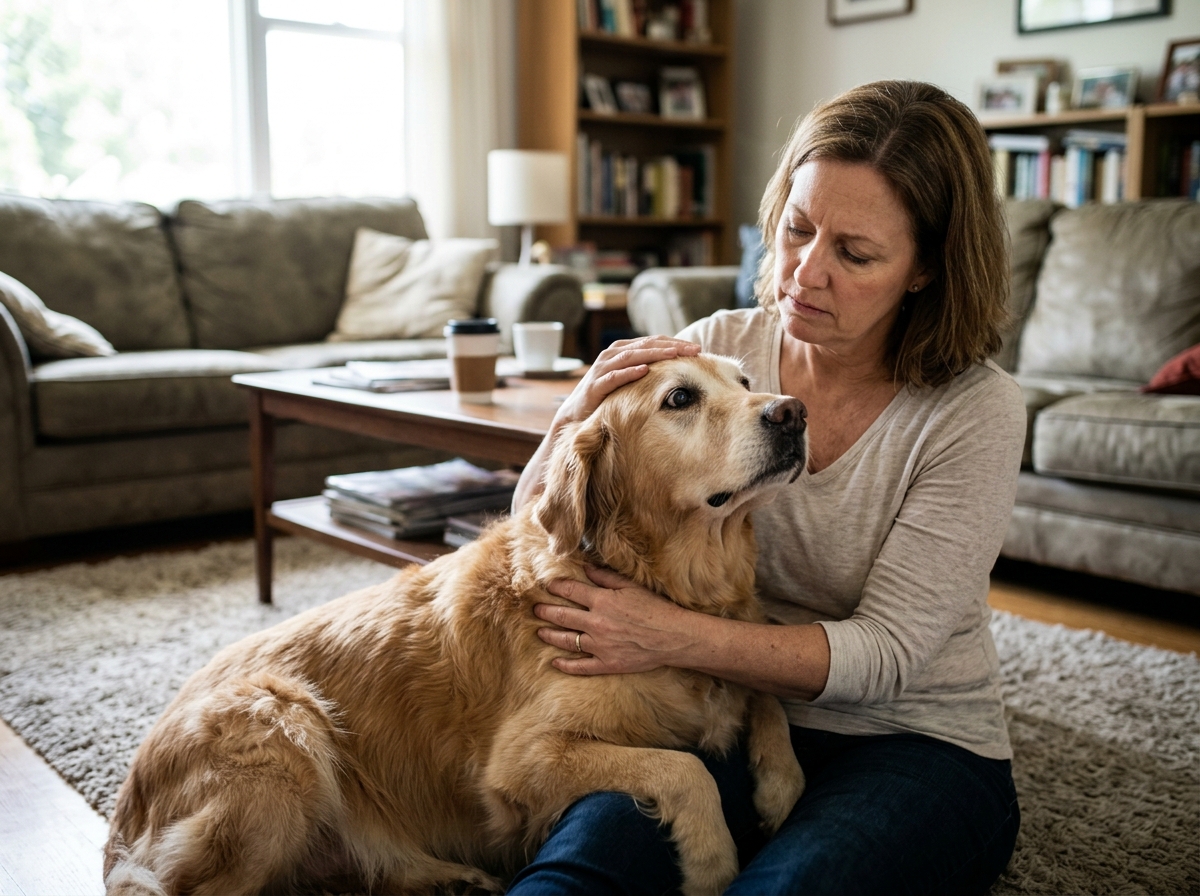
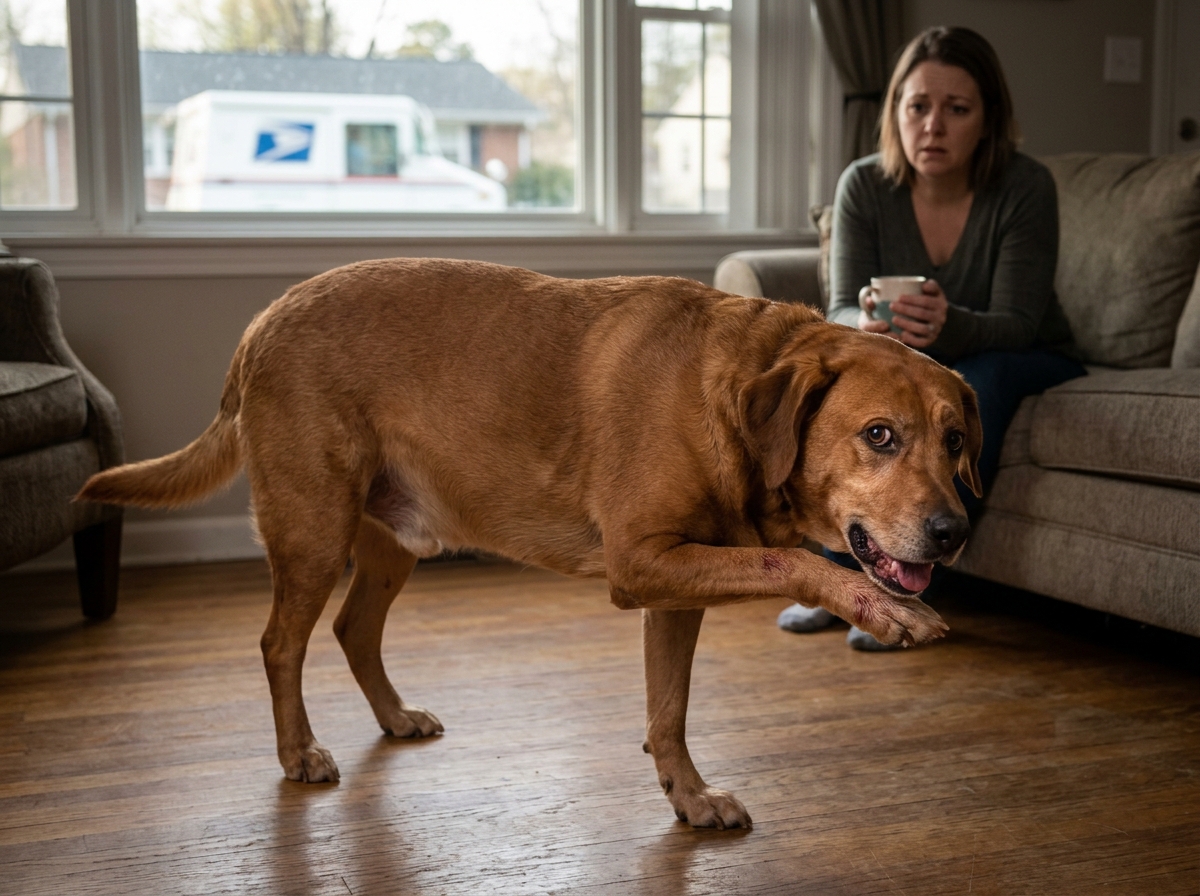
If your dog has slowly gotten heavier, slower, and more "on edge" over the last year or two - pacing when the mail truck rolls up, panting on the couch in a cool room, licking their paws raw at night, staring at you with those wide, unsettled eyes - you are not looking at a training problem. You are not looking at a treat problem. And you are almost certainly not looking at a "getting older" problem.
You are looking at a chemistry problem.
Specifically, you are looking at what happens inside a dog's body when a stress hormone called cortisol stops behaving the way it should. And the story of how that one hormone can quietly reshape your dog's waistline, mood, sleep, and joints - all at the same time - is the story most owners have never been told.
Once you understand it, three things that used to seem unrelated finally click into place: the anxiety, the weight, and the exhaustion.
Before we get into the science, read this list. If two or more sound like your dog, keep reading - this article was written for you.
You've cut their food. You're walking them every day. You switched to the "weight management" kibble the vet recommended. You've tried the calming chews from the pet store aisle. And somehow, nothing has really moved.
There is a reason. And it has almost nothing to do with willpower.
Cortisol is your dog's primary stress hormone. In healthy amounts, it does exactly what evolution designed it to do - it wakes them up in the morning, gives them energy to chase a squirrel, and settles back down at night so they can sleep.
The problem is that modern dogs are not running from wolves.
They are living in houses with doorbells, delivery trucks, other people's dogs, fireworks, thunder, vacuums, changing schedules, and long stretches of being alone. Their nervous systems don't get the "the threat is over" signal the way a wild dog's would. So cortisol stays quietly elevated - not in dramatic spikes, but in a low, constant hum.
Here is what that low, constant hum does, according to how the endocrine system in mammals actually works:
Chronic cortisol signals the body to preserve energy for a threat that never comes. Fat goes on. Fat stays on. Even when calories drop.
The gut stops fully absorbing fat-burning nutrients. Cells stop efficiently converting stored fat into usable energy. Your dog can eat less and still gain weight - which is exactly what so many owners report.
Cortisol dysregulation and systemic inflammation feed each other. That extra weight now presses on joints that are already inflamed. The stairs get harder. The couch becomes a "stare at it" object.
The pacing. The panting. The paw-licking. The 3am wake-ups. These are not bad behavior. They are the visible symptoms of a nervous system that never gets to fully stand down.
And now you have a loop. Anxiety raises cortisol. Cortisol wrecks sleep and metabolism. Poor sleep and slow metabolism raise anxiety. Around and around it goes.
By the time you notice your dog is "just anxious" or "just getting chunky," the loop has usually been running for months.
Most owners try the same two things, in the same order.
First, they try a calming chew. It works for a day or two - or seems to - and then the pacing comes back.
Then they try prescription weight-management food. They measure every cup. They cut every treat. They stop the table scraps. And they wait.
One owner shared her story with the PawPrint Lab team. She spent $2,200 over 11 months on prescription weight-management food for her black lab. She did everything right. After 11 months and $2,200, her dog was heavier, slower, and more anxious than when she started.
She had not failed her dog. The approach had failed her dog.
Here is why: calming chews address the symptom (anxiety) without touching the metabolic environment that keeps producing it. And "weight management" kibble addresses calories without touching the hormonal signals telling the body to hold onto fat and stay wired.
If you don't fix the underlying chemistry, the dog stays stuck. Full stop.
Science is finally catching up to what experienced vets have been quietly saying for years: weight gain and anxiety in dogs are rarely separate problems. They are two symptoms of the same underlying metabolic dysfunction.
To break the loop, you have to hit it from several angles at once:
That is not one supplement. That is five or six of them.
And here is the problem every owner runs into: your dog will not eat five capsules a day. They spit them out. They eat around them. They figure out which "treat" is hiding a pill and refuse it. You end up throwing money in the trash.
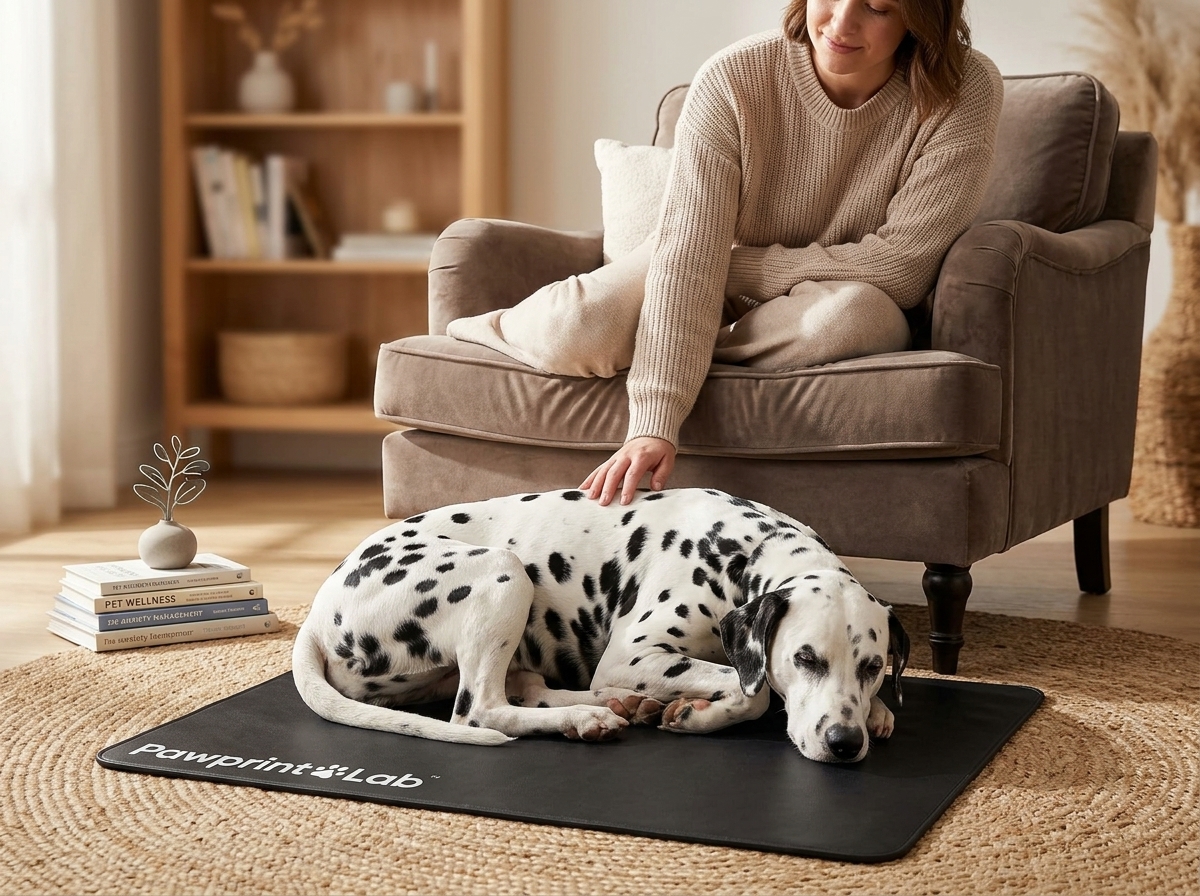
The team at PawPrint Lab built Pawprint Wellness Protocol for exactly this problem.
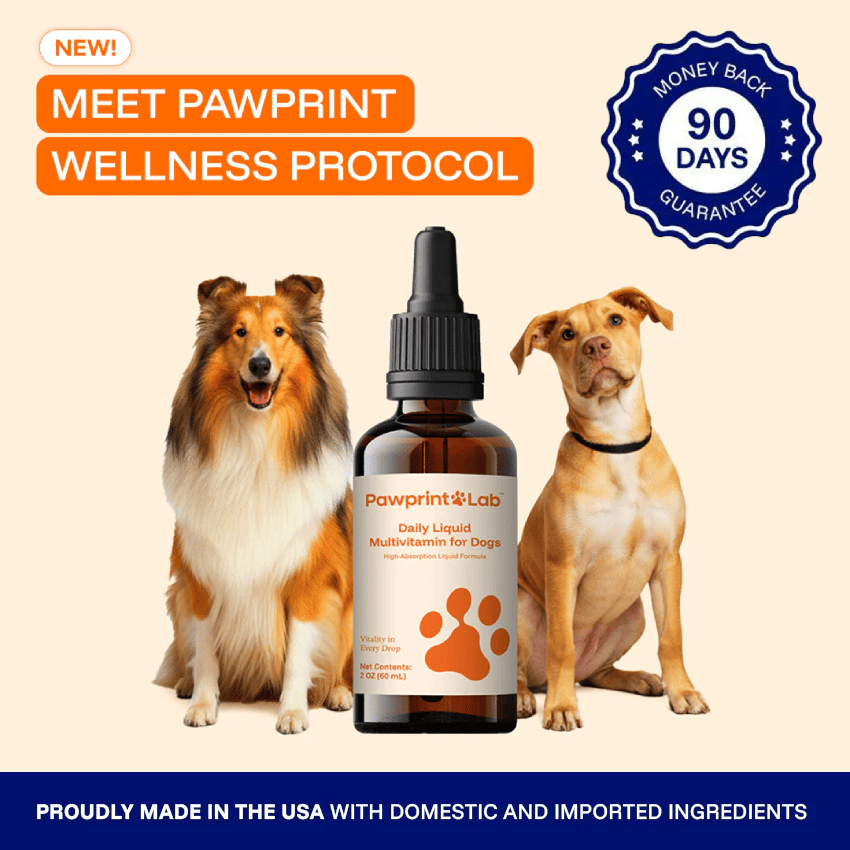
It is a daily liquid supplement for dogs that addresses the metabolic and inflammatory causes of weight gain and anxiety - not just the calories. You mix a few drops into whatever your dog already eats. Kibble, raw, home-cooked, wet, freeze-dried. It doesn't matter. The dog eats it because they can't tell it's there.
Inside every bottle:
It replaces 5+ separate supplements most owners are already trying to give (and failing to get down).
It works alongside any diet. It does not require a prescription. It does not require you to change food, change vets, or change your routine.
You just add the drops. The formula does the work.
Based on the way the formula is designed to work, here is the typical arc owners describe:
The ingredients start absorbing. Owners often notice their dog seems a little "brighter" - more interested in walks, more responsive at the door.
The stiffness on stairs starts to ease. Dogs get up from naps faster. The "hesitation" before jumping onto the couch begins to disappear.
The body starts using stored fat as fuel more efficiently. The waistline starts to reappear. Owners report their dog is calmer in the evenings - the 4pm pacing loosens its grip.
Sleep normalizes. Anxiety-driven behaviors (paw licking, night waking, doorbell reactivity) settle down as inflammation and cortisol both come down. The dog you remember from three years ago starts showing up in the doorway again.
Healthy weight changes take time. There is no overnight version of this. But the arc is real, it is repeatable, and it is built on how a dog's body is actually supposed to work when you stop starving it and start feeding it what it needs.
The reason the "diet food" approach has failed so many households is simple: it treats a dog's body like a calculator. Calories in, calories out. But dogs are not calculators. They are complex hormonal systems, and when cortisol and inflammation are running the show, no amount of portion-cutting is going to override the chemistry.
The correct sequence is to calm the inflammation, restore the metabolic machinery, and take the physical load off the joints. When you do those three things, the anxiety comes down on its own - because the nervous system finally gets the "you are safe, you are fed, you are fine" signal it has been waiting for. And the weight comes off on its own too, because the body is finally allowed to use it.
That is the whole game. Everything else is a distraction.

If you're in the first group, keep reading.
PawPrint Lab is currently offering new customers 30% off and free shipping on Pawprint Wellness Protocol so you can try it in your own home, on your own dog, without commitment.
You add the drops to your dog's normal food once a day. That's the whole protocol. Ten active ingredients doing the work of five-plus separate supplements, in a form your dog will actually eat.
You can start today.
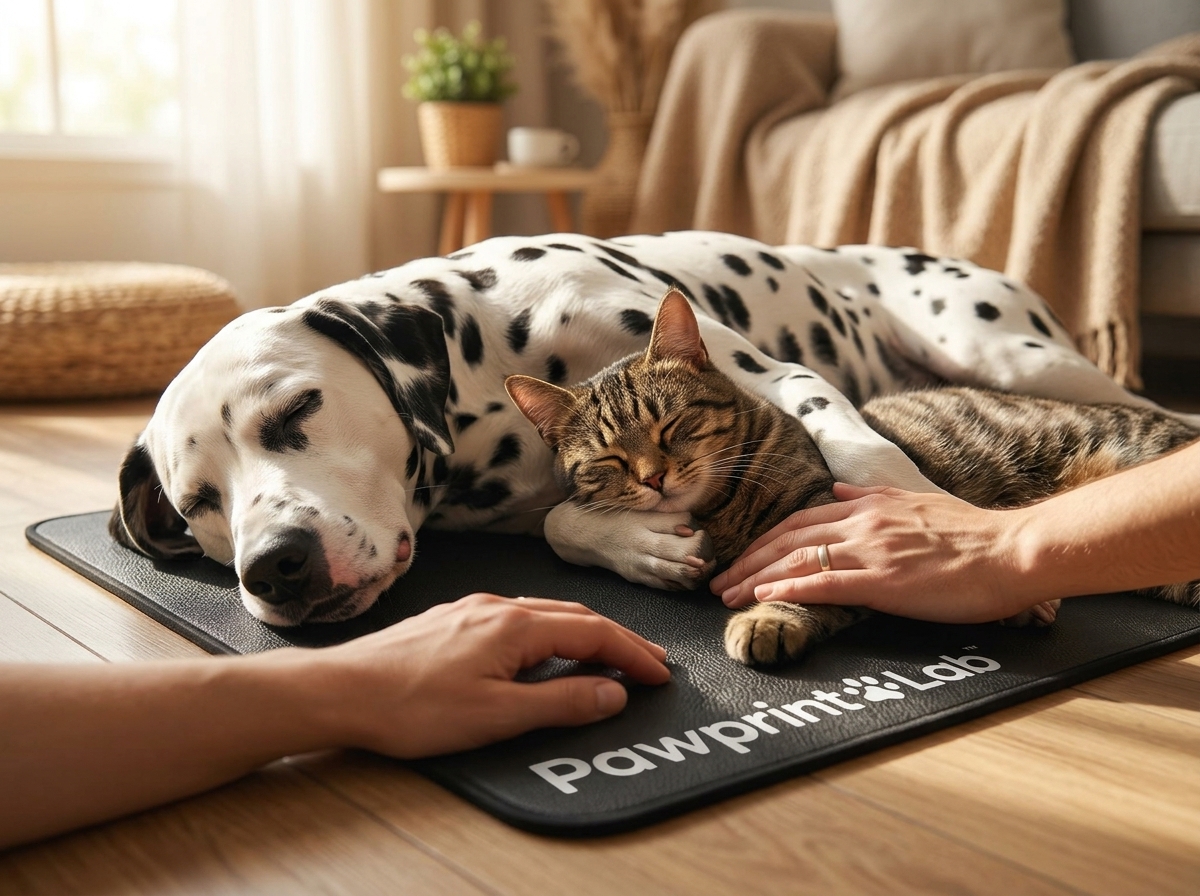
Your dog's weight isn't just too many treats. Your dog's anxiety isn't just their personality. They are two faces of the same underlying problem - a stress-hormone-driven metabolic loop that has quietly taken over the body of a dog who used to sprint up the stairs, jump on the couch, and pull you down the sidewalk.
You can keep cutting food and hoping. Or you can address the actual chemistry.
The dog you remember is still in there. The formula just gives their body permission to come back.