

You run a hand down his back and it comes away with more fur than it should. Then you see the patch — one place where the coat no longer looks like him. Hair loss is a sign, not a diagnosis, and it has many possible causes. This page will not tell you which one it is. It shows you five things worth photographing and writing down, so your veterinarian starts from observations instead of guesses. A photo is not a diagnosis.

Most older dogs shed, and many shed harder in certain seasons. The first thing worth separating is diffuse shedding that still leaves a full-looking coat from an area where you can now see skin. The Merck Veterinary Manual defines alopecia as the partial or complete lack of hair where it is normally present. Write down which of the two you are looking at, where, and roughly how large — a coin or a fingertip is a good unit — then take one photo from above in good daylight.
The kitchen, where the light is best, is also where his food goes down — and, for Protocol households, a dropper on that food: NMN, the direct building block cells use to make NAD+, once a day.
If a bald area appeared within days, or the skin under it looks raw, do not wait for the checklist — see your vet.
| What you notice | What to write down |
|---|---|
| Fur on the sofa, coat still looks full | Shedding; no visible skin |
| A thinner area you can part with your fingers | Partial loss; where, and how large |
| Skin clearly visible through the coat | Bald area; size in coins or fingertips |
| Thin or bald in several places | How many areas, and where each one is |
| More fur in the brush than last season | Since when; still increasing? |
Pattern says more to a veterinarian than it does to a mirror. Merck notes that acquired hair loss may affect an isolated spot or multiple areas, or it may be symmetric or widespread. You do not need to know what each pattern means, only to describe it accurately. Stand behind the dog and compare the left side with the right, then photograph him from above and from each side in the same light. Tick every word below that fits; the meaning is the question you bring to the appointment.
NAD+ is a small helper molecule cells spend in hundreds of everyday jobs, turning food into energy among them. Pawprint Protocol supplies its building block, NMN, in a liposomal liquid built to be absorbed, not just swallowed.

The second question your veterinarian will ask is whether the area itches or hurts. Merck's guidance is direct: if a dog has hair loss and is also scratching the area excessively, the itching should be investigated first. You are not deciding why he scratches. You are counting how often, at what time of day, and whether the licking, chewing or flinching started before the patch showed up or after it.
How to record it
When the vet asks what he eats and takes, Protocol's label reads out in one breath: NMN, NAD+, resveratrol and CoQ10 — four actives, each with a job.
A dog that flinches or growls when the area is touched is telling you it hurts. That is a vet visit, not a grooming question.

A single photo shows a patch. A dated series shows a direction, and progression is one of the points Merck says a veterinarian needs in the history, alongside duration, whether there is itching, and the dog's general health. Keep it simple: same room, same light, same three angles. None of this replaces the physical examination, skin scrapings or laboratory tests that only a veterinarian can do.
Tie the weekly photo to the routine you already keep — his morning meal, the dropper of Protocol on the food — so the record and the habit share one moment.

Part the coat and look at the skin itself, in daylight if you can. Merck lists inflammation, thickened skin, colour change, scaling, excessive shedding and itching as common alongside acquired hair loss. Describe, do not name: red or not, flaky or smooth, darker or lighter than nearby skin, thickened or normal, any smell. Photograph it close, with a coin beside it for scale, and leave the bathroom cabinet closed until someone has examined it.
Protocol does its work from inside the daily meal: each active wrapped in a liposomal layer so more of what's in the dropper reaches the cell.

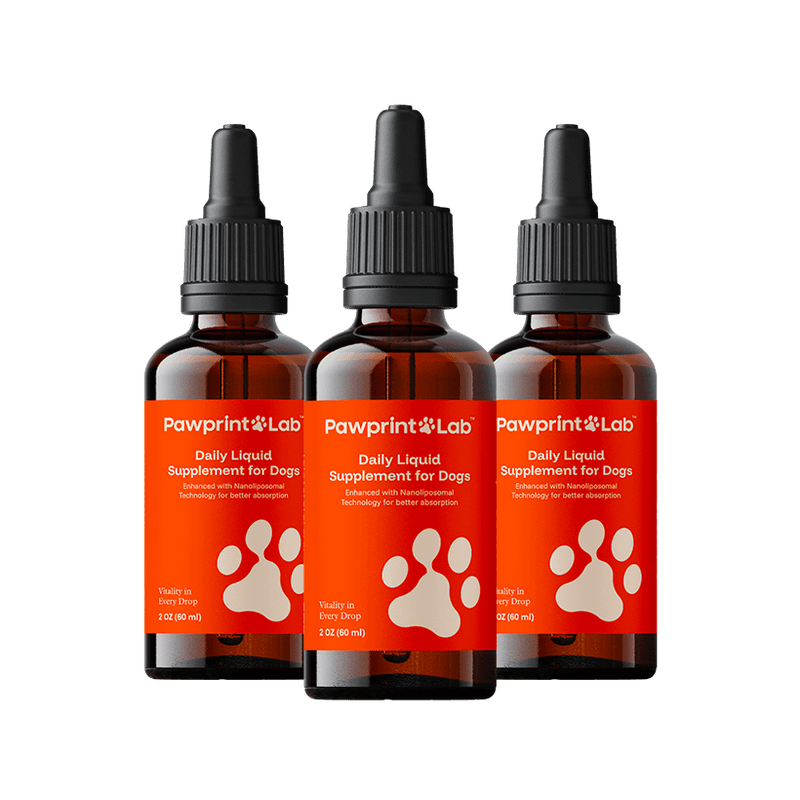
Pawprint Protocol is a dietary supplement, not a medicine.


