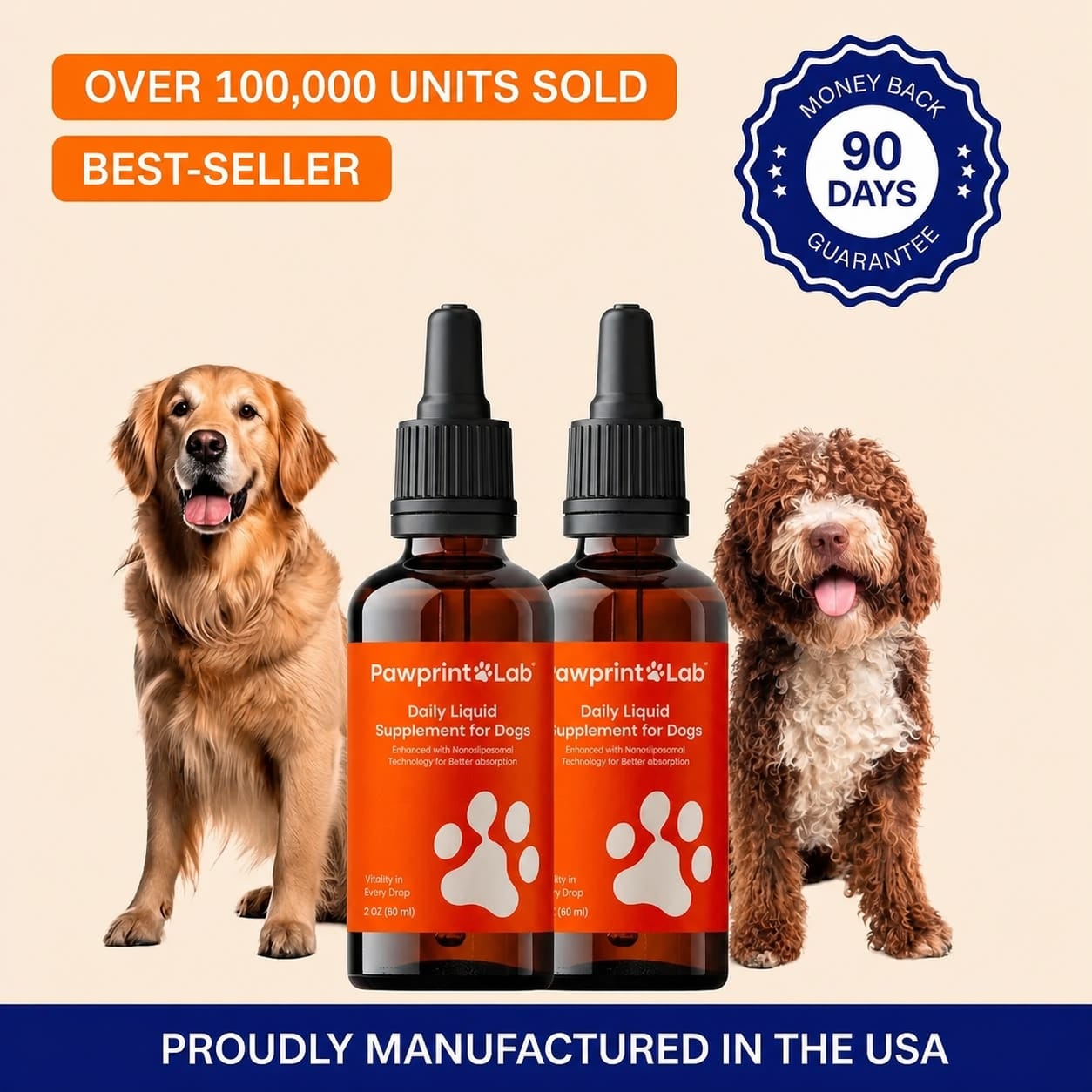
Thank you for your continued interest in Pawprint Protocol. Please note that Pawprint Protocol is sold exclusively through our official website at pawprintlab.com. We do not distribute through Amazon, third-party retailers, or any other marketplace. Any listings found elsewhere are not authorized by us, and we cannot guarantee authenticity or quality.
Due to recent demand, availability may vary, and certain inventory batches may sell out from time to time. We encourage customers to check the page below for the most current availability and shipping timelines. Pawprint is offered with a 90-day money-back guarantee so you can evaluate whether it fits your wellness routine with confidence.
We appreciate your trust and support.

Dogs typically start showing signs of aging, including health issues and cognitive decline, at around 7 years old. Cognitive decline similar to dementia begins appearing around 8-10 years. Signs may include disorientation, confusion, and altered sleep patterns, though timing varies by breed and size.
Pawprint Protocol works to help address this decline by providing your dog's system with essential nutrients.
reduction in cognitive decline markers within 90 days*
of dogs showed improved heart health indicators in just 4 weeks*
less age-related muscle loss after 6 weeks*
*Backed by peer-reviewed studies on the individual ingredients
Pawprint Protocol uses advanced nanoliposomal technology to help enhance nutrient absorption. By encapsulating ingredients in tiny nanoliposomes, nutrients can bypass the liver and be delivered more directly into the bloodstream through cell membranes. This approach supports higher bioavailability, helping ensure your dog receives maximum benefits with improved health and energy outcomes.
Pawprint Protocol follows the highest ethical standards when creating our supplements. We ensure your pooch gets the best ingredients from the safest labs and manufacturers in America.
We’re so sure you’ll love our product, we offer a 90-day money-back guarantee on our nanoliposomal protocol.
Katherine E. Simon, Katharine Russell, Alejandra Mondino et al. “A randomized, controlled clinical trial demonstrates improved owner-assessed cognitive function in senior dogs receiving a senolytic and NAD⁺ precursor combination.” Scientific Reports 14:12399 (2024).
Ming You, Xiumei Fan, Liang Tao et al. “Sub-acute toxicity study of nicotinamide mononucleotide via oral administration in beagle dogs.” Toxicology Reports 8:40–52 (2021).
Déborah Cardoso, Inès Barthélémy, Stéphane Blot et al. “Replenishing NAD⁺ content reduces aspects of striated-muscle disease in a dog model of Duchenne muscular dystrophy.” Skeletal Muscle 13:20 (2023).
Zhaowei Bian, Ziyang Li, Hao Chang et al. “Resveratrol ameliorates chronic stress in kennel dogs and mice by regulating gut microbiome and metabolome related to tryptophan metabolism.” Antioxidants 14(2):195 (2025).
Rachel L. Poole, Emily R. Woodall, Philip K. Byers et al. “Pharmacokinetic analysis of an oral multicomponent joint dietary supplement (containing trans-resveratrol) in dogs.” Pharmaceutics 9(3):30 (2017).
Ainara Tvarijonaviciute, Pablo Escribano-Durán, Aránzazu Torre-Noguera et al. “Effects of Coenzyme Q10 supplementation on oxidative stress and clinical status in dogs with mitral valve [issues].” Antioxidants 11(8):1427 (2022).
Liselotte B. Christiansen, Malene K. Morsing, Maria J. Reimann et al. “Pharmacokinetics of repeated oral dosing with Coenzyme Q10 in Cavalier King Charles Spaniels with myxomatous mitral valve [issues].” Antioxidants 9(9):827 (2020).
Katarzyna Zabielska-Koczywąs, Roman Lechowski, Joanna Łojkowska et al. “The use of liposomes and nanoparticles as drug delivery systems to improve [condition redacted] treatment in dogs and cats.” Molecules 22:2167 (2017).
Yaarit Shilo-Benjamini, Eran Lavy, Noam Yair et al. “Therapeutic efficacy and pharmacokinetics of liposomal-[active redacted] injection: a pilot clinical study in dogs with naturally-occurring osteoarthritis.” Frontiers in Veterinary Science 10:1224452 (2023).
Margaret L. Hauck, Steven M. LaRue, Paul W. Petros et al. “Phase I trial of doxorubicin-containing low-temperature-sensitive liposomes in spontaneous canine [condition redacted].” Clinical Cancer Research 12(13):4004–4010 (2006).