
By Avery Quinn
Published Today
A diagnostic guide for owners who are tired of the "rest and wait" cycle - and want to know what a recurring limp is actually telling them.

Day one, your dog jumps off the couch, comes up favoring a back leg, and gives you that look. You do what any good owner would do. You cut the walks in half. You skip the fetch session. You keep him off the stairs.
Three days later, he seems fine. Five days later, he's chasing the mailman like nothing happened. You exhale. Crisis over.
Then day nine hits. He's up from his bed, stiff. Or he lands wrong coming down from the truck and you see it again - that same little hitch in the stride. The limp is back.
And now you're standing in the kitchen wondering the same thing thousands of dog owners wonder every single week: is this serious, or is he just a little sore again?
If that cycle sounds familiar, this article is for you. Because there is a simple rule veterinary professionals use to separate a true muscle strain from something deeper - and most owners have never heard it.
It's called the 14-Day Rule.

Here is the rule, straight up:
That's it. That's the framework.
The reason it matters is that muscle tissue in dogs, like in humans, has good blood supply and heals on a predictable timeline. Give it two weeks of relative rest and a true pulled muscle should be behind you. Done. Case closed.
Joints, cartilage, and ligaments are a different story. They have poor blood supply. They don't repair themselves the way muscle does. And when they're the actual source of the pain, rest doesn't fix them - it just quiets the signal long enough for you to think the problem is gone.
That's why the limp comes back.
That's why you're on cycle number four, or seven, or eleven of rest-improve-recur.
Recurrence is information. Your dog is telling you something. The question is whether you're going to keep resetting the clock every time - or actually listen.
Let me walk you through the pattern I want you to look at on your own dog. Grab your phone calendar or a notebook. Seriously - this exercise is the whole point of the article.
Write down the last time you noticed a limp. Not the most recent one. The last three or four times.
For each episode, fill in four things:
Now count the gap between the "all better" date and the recurrence date on the most recent episode.
If that gap is less than 14 days, you are inside the strain window and rest may still be doing its job.
If that gap is longer than 14 days - or if you're looking at three, four, or more episodes over the past several months - the pattern itself is the diagnosis. That is not a strain. That is a joint, cartilage, or ligament issue asking for a different plan.
This is the mental model most owners never get handed. And once you see it, you cannot unsee it.
Rest is a fantastic first move. It is exactly what you should do the first time a limp shows up. Nobody is telling you otherwise.
The problem is that rest is a test, not a treatment.
Rest tests whether the tissue can heal on its own inside the strain window. If it heals and stays healed, great - it was a strain, and the test passed.
If it heals, then breaks down again a couple weeks later, the test just gave you the opposite answer. It told you the underlying tissue is not repairing. It is compensating. It is masking. It is waiting for the next jump off the couch, the next slippery floor, the next long walk.
That is why owners on cycle five or cycle eight of rest-improve-recur feel like they're losing their minds. They're doing everything "right." The problem is that rest alone was never designed to solve the thing that's actually happening under the hood.
Cartilage doesn't rebuild from a nap. Joint fluid doesn't replenish from a week on the couch. Chronic inflammatory signals in the joint don't quiet down because you skipped Saturday's hike.
Those things need daily nutritional support - the raw materials the joint uses to cushion, lubricate, and calm itself. Every day. Not every crisis.
Run your dog through this list. Be honest with the answers.
If you're checking boxes in that second list, you are not looking at a strain anymore. You're looking at a dog whose joints are asking for something rest cannot provide.
And this is the moment to stop resetting the calendar and start giving the joint what it actually needs, every single day.
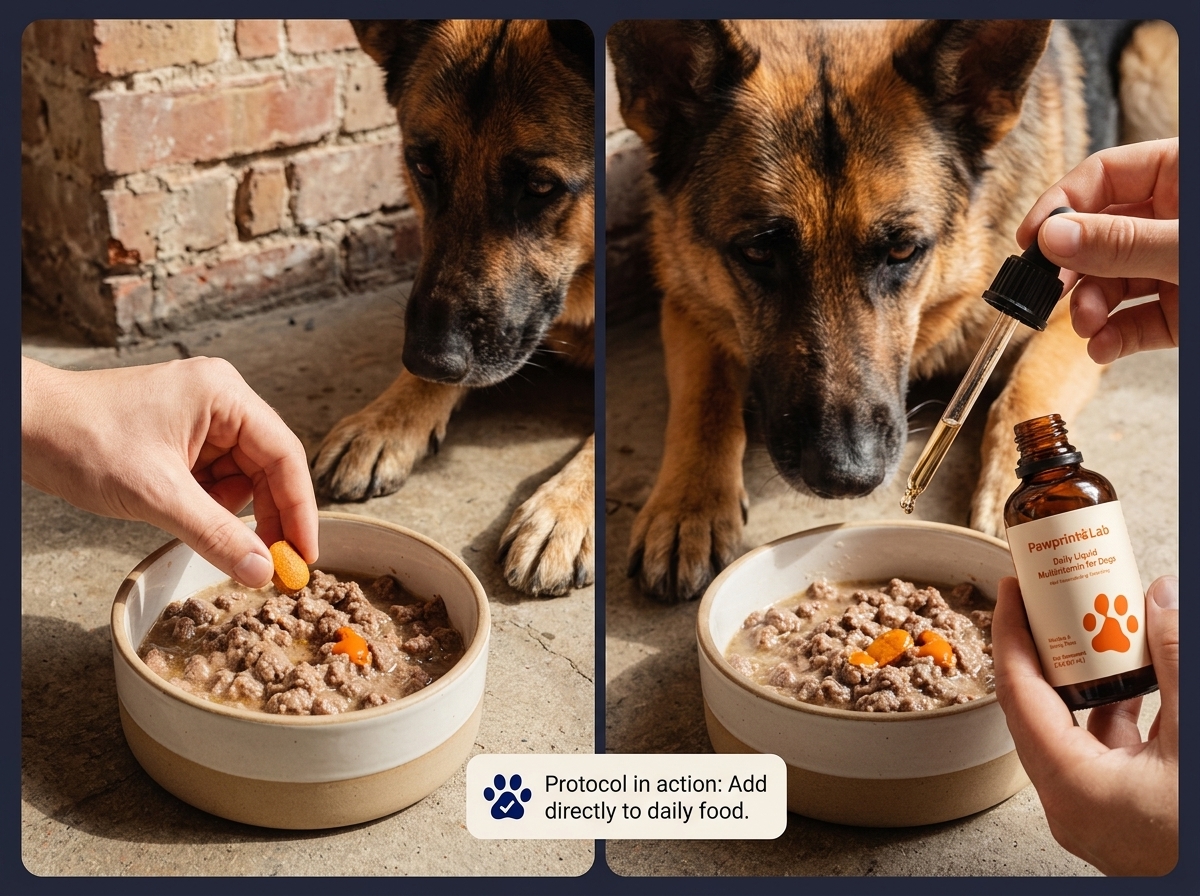
Here's the part no one explains clearly. When a joint has crossed out of "strain" and into "wear," the underlying tissue is short on a specific set of raw materials.
Read that list again. That's not one supplement. That's five or six of them.
And here's the punchline every dog owner already knows: your dog is not eating six supplements a day. He's spitting out the glucosamine chew, he's leaving the fish oil capsule in his bowl, and he's giving you a look that says nice try when you try to hide a turmeric tablet in cheese.
That is exactly the gap the Pawprint Wellness Protocol was built to close.

Pawprint Wellness Protocol is a daily liquid formula for dogs that replaces 5+ individual supplements in a single bottle. It's reviewed by Dr. Mark Saraiva, DVM. It's made in the USA in a cGMP-compliant facility under 21 CFR Part 111 standards. And it's been used by owners who bought over 100,000 units.
The whole design philosophy is stupidly simple: no chews, no powders, no pills your dog will refuse. Just liquid drops on top of the food he already eats.
Every 1 mL serving delivers:
That's every raw material listed in the joint-support section above. In one dropper.
The dosing chart is built around weight, so there's zero guesswork:
Give it with food for higher absorption. That's the entire routine. Meal, drop, done.
For a medium dog, one 2 fl oz bottle covers the daily protocol. And because it's a liquid, the picky-eater problem disappears - it mixes into whatever he's already eating.
The reason we recommend a minimum 90-day run isn't marketing. It's biology. Joint tissue rebuilds slowly. You are giving the body raw materials it has been short on, and it takes time to see the compound effect.
Here's the general timeline owners report:
Every dog is different. Progress builds with daily use. But the reason we ask for a full 90 days is that 90 days is when the picture usually becomes obvious.
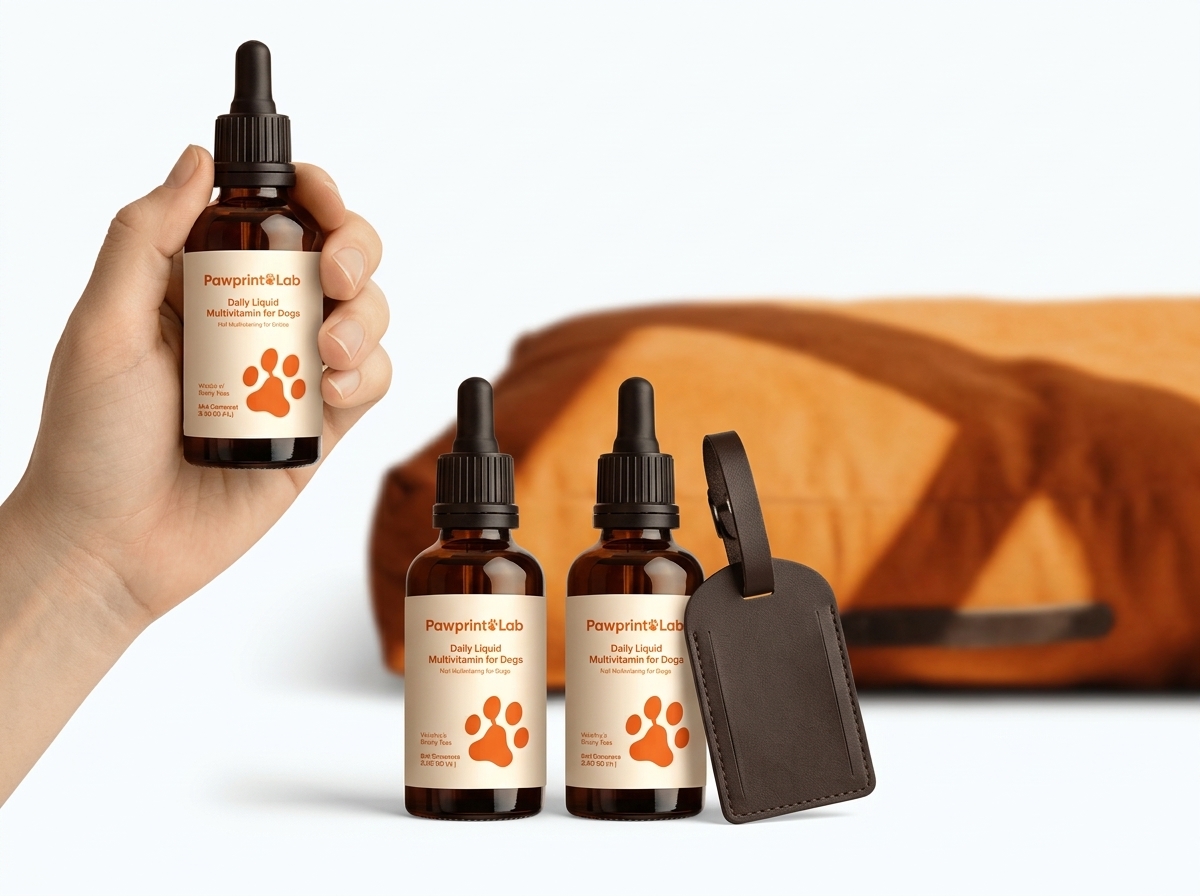
Here's how Pawprint set this up so you can start today without a coin-flip decision:
Subscription pricing lands at roughly $1.33-$1.63 per day depending on the package. Cheaper than a coffee. Cheaper than one bad "wait and see" cycle at the vet.
And the 90-day guarantee is the exact window the protocol is designed to work in. Run it for a full 90 days. If you don't see the difference, get your money back. That's it.
"My dog's limp comes and goes. Isn't that normal?"
Coming and going is the observation that matters. A true strain doesn't come and go on a rolling schedule. Recurrence is the signal that the underlying tissue needs daily support, not another rest cycle.
"Should I just keep resting him?"
Rest is the right first move. It is not a long-term answer to a recurring pattern. Rest tests the strain window. When the limp keeps returning outside that window, rest has already given you the answer - the tissue needs more than a nap.
"Is Pawprint a treatment?"
No. It's daily nutritional support - the raw materials the joint uses to cushion, lubricate, and stay balanced. If you suspect a serious injury like a torn ligament or a fracture, that's a veterinary conversation. This is what you give the dog every day so the joint has what it needs to keep doing its job.
"How long before I know if it's working?"
Give it a full 90 days. That's what the guarantee is built around. Owners typically notice changes in month one, but the full compound effect shows up over three months.
"What if he doesn't like the taste?"
The formula is designed to be added to food. Because it's liquid, you're not fighting the pill-in-cheese battle. Most dogs eat right through it.
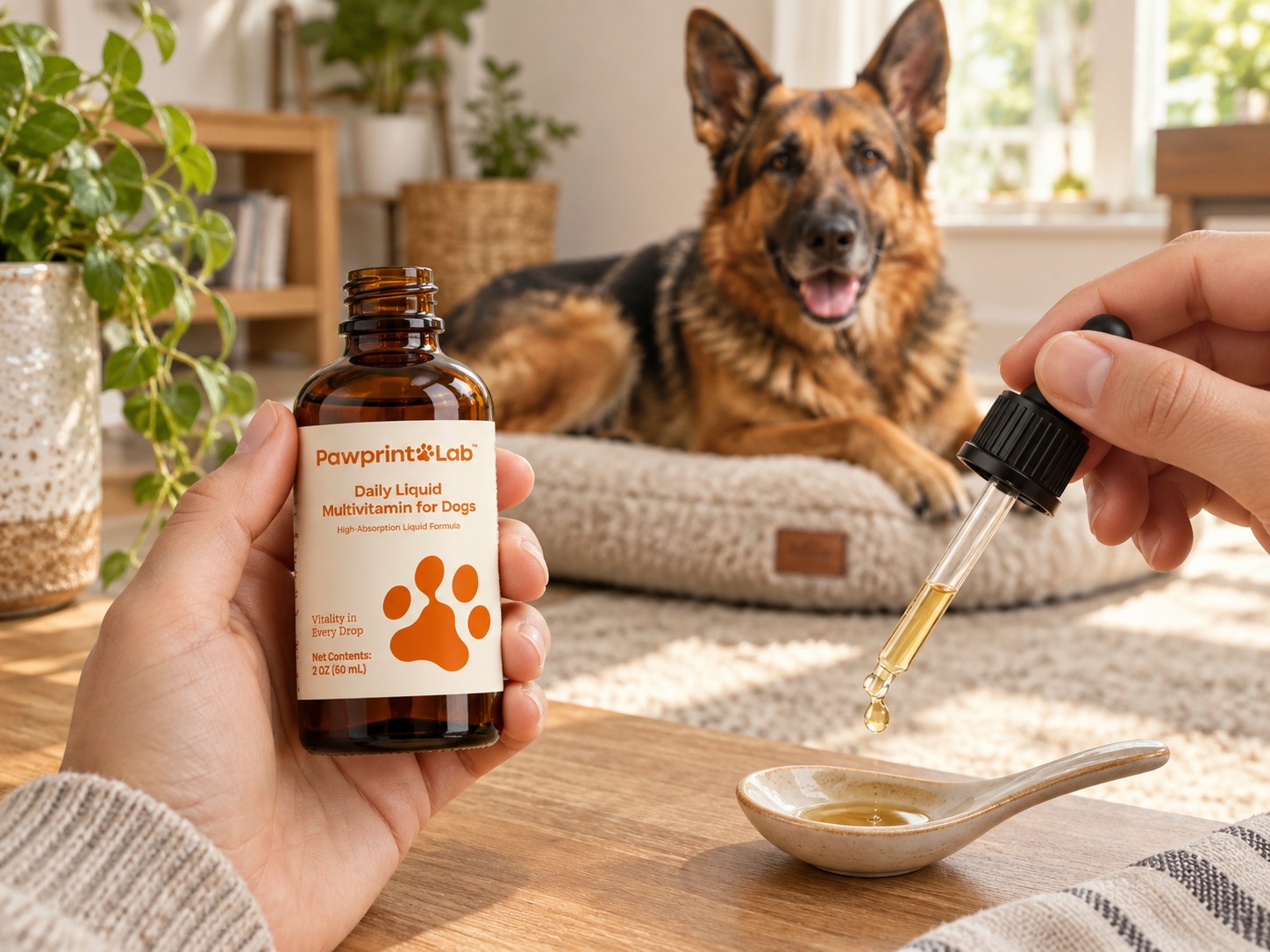
Every time you go through another rest-and-wait cycle, you're doing two things. You're being a responsible owner - and you're losing time.
The 14-Day Rule is not a diagnosis. It's a decision tool. It tells you when the "wait and see" strategy has run out of runway, and when the smart move is to start feeding the joint what it actually needs, every day.
You have a good dog. You've watched him get up a little slower than he used to. You've watched him think twice about the stairs. You've already done the resting, the babying, the watching, the worrying.
Give him the raw materials his joints have been asking for. Give it 90 days. And if it isn't the difference you were hoping for, get your money back.
That's the deal.


