

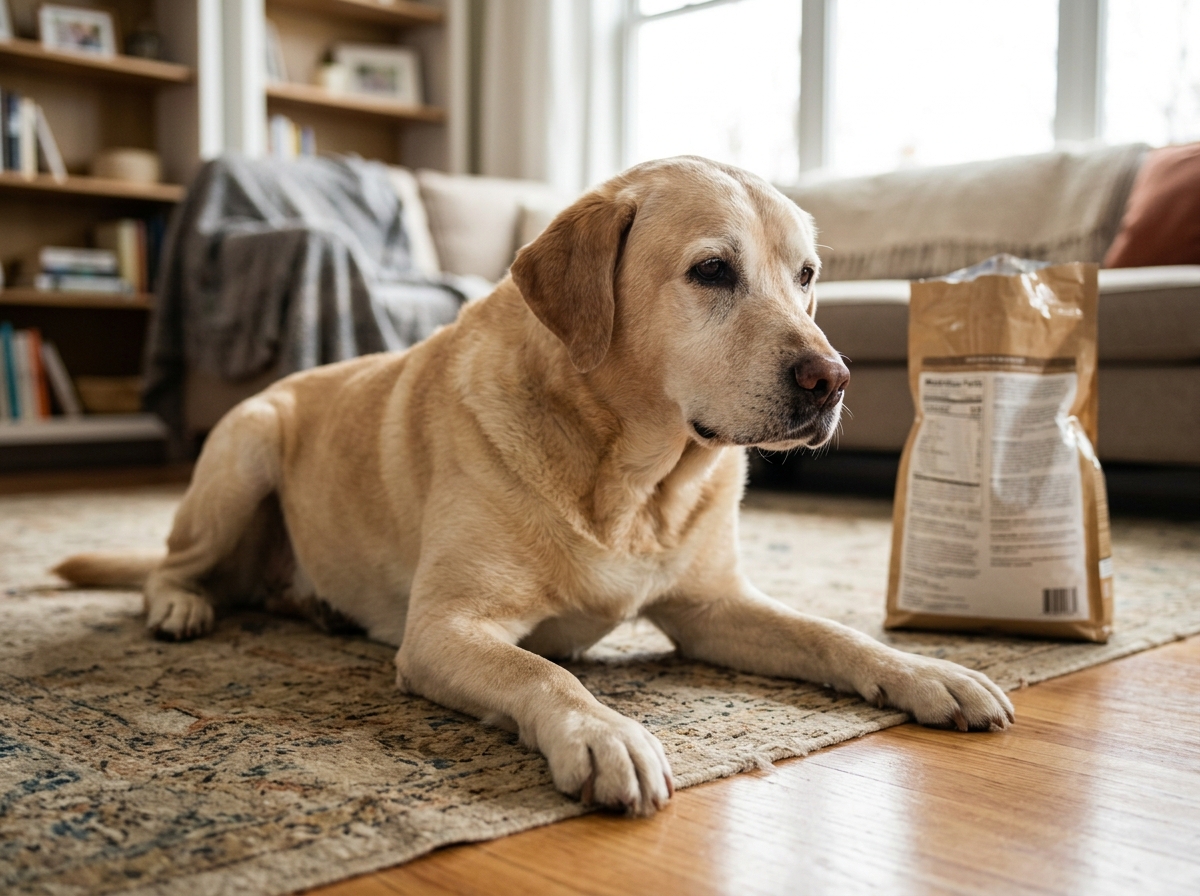
Go pick up your dog's food.
Turn the bag around. Find the ingredient panel. Now scan past the first three lines - past the chicken, past the rice, past the "wholesome grains" your dog jumps for every morning - and look for one specific word.
Oil.
Corn oil. Soybean oil. "Vegetable oil." Sometimes it's buried near the middle of the label. Sometimes it's tucked between the tocopherols and the "natural flavor." But on a huge percentage of premium, mid-tier, and even veterinarian-recommended kibbles, it's in there.
And if your dog is over the age of six, moving a little slower on the stairs, taking an extra second to get up off the rug, or hesitating before jumping in the car - that one line on the label may be part of a conversation you've never been invited into.
Because veterinary researchers ran a study on dogs with osteoarthritis. They compared two oils. And what they found should make every owner of an aging dog stop, re-read the bag, and rethink what "joint support" actually means.

Most owners of stiff, slower-moving dogs think joint support is a one-ingredient problem.
You add glucosamine. Maybe chondroitin. Maybe a chew shaped like a bacon strip. You tell yourself you're doing the right thing, because that's what the pet store tells you, that's what the vet clinic hands you at checkout, and that's what every ad on Instagram promises.
But the peer-reviewed research titled "Evaluating oxidative stress, serological and haematological status of dogs suffering from osteoarthritis, after supplementing their diet with fish or corn oil" did something different. It didn't ask, "Which joint pill works best?" It asked a much better question:
What happens inside an arthritic dog's body when you change the fat in the diet?
The researchers took dogs already suffering from osteoarthritis and split them into groups. One group got fish oil - rich in EPA and DHA omega-3s. The other group got corn oil - rich in omega-6 linoleic acid. They tracked blood markers, oxidative stress, and inflammatory status.
The fish-oil group and the corn-oil group did not respond the same way.
That is the entire lesson. It is not a headline about a miracle cure. It is a headline about the fatty-acid environment your dog lives in every single day.
And that environment is set by the oil on the back of the bag.
Here's what I want you to sit with for a moment.
Cartilage is a building. Glucosamine, chondroitin, MSM, and hyaluronic acid are the bricks, the mortar, the water in the walls. Great. Add them. Your dog needs them.
But bricks don't build a house in a hurricane.
The fatty acids in your dog's food are the weather. Omega-3s (EPA and DHA) tilt the daily inflammatory signaling toward calm. Omega-6s, when they dominate the diet without an omega-3 counterweight, tilt it the other way. Both fats are essential. The ratio is what quietly runs the show.
And in a huge chunk of commercial dog foods, the ratio is a landslide. Corn oil, soybean oil, "poultry fat" - these ingredients are cheap, shelf-stable, and calorie-dense. They deliver energy. They do not deliver EPA or DHA.
So the owner does what a good owner does. They buy the joint chew. They add the glucosamine. And they wonder, six months later, why the dog is still slow on the stairs.
The bricks were fine. The weather never changed.
I hear this every time this conversation comes up, so let's handle it head-on.
Premium dog food is not the villain in this story.
A good bag of kibble - or a fresh diet, or a raw plan, or whatever routine you've built - is the foundation. It delivers protein, calories, fiber, vitamins, and minerals. It keeps your dog alive and thriving. Nothing in this article is asking you to change what's in the bowl.
But foundational food and targeted joint support have two different jobs. The food feeds the whole dog. Targeted support hits one specific system - in this case, the joints, the cartilage, and the fatty-acid environment those joints live in.
Even the best premium foods often add corn, soybean, or omega-6-heavy oils for palatability, shelf life, and cost. Some add fish oil too, but rarely in the concentrated, guaranteed amounts an arthritic dog needs day after day after day.
That's why the smart move isn't to throw away the food you already trust. The smart move is to layer in the missing piece - the EPA and DHA, plus the joint-building blocks - in a form you can measure, dose, and count on.
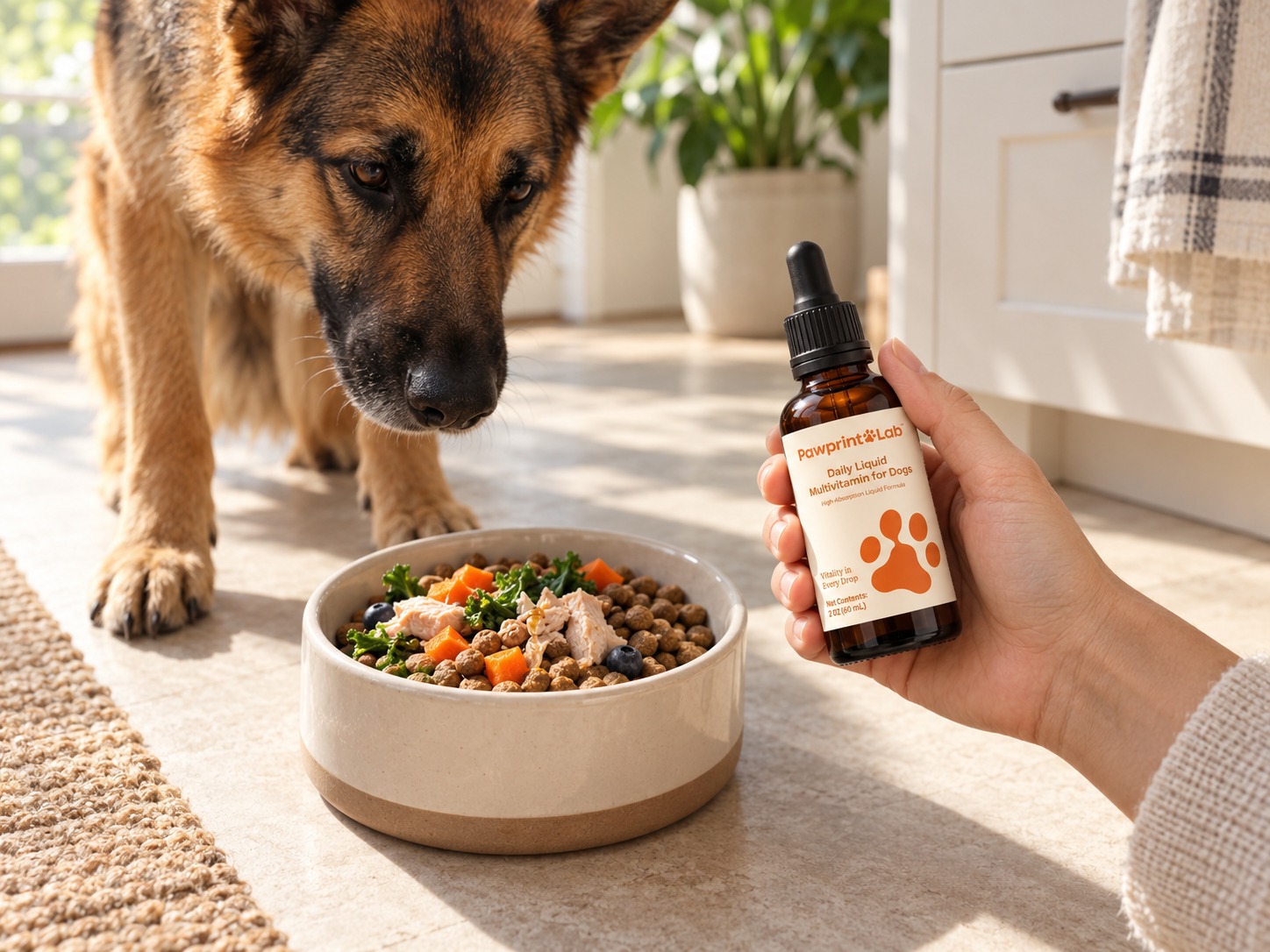
This is where Pawprint Wellness Protocol comes in.
Pawprint Wellness Protocol is a daily liquid drop supplement for dogs, sold at pawprintlab.com. It's designed to be added to the food your dog already eats. No pills. No chews your dog spits out. No powders that end up on the floor.
Just a marked dropper, a bottle of high-absorption liquid, and one small ritual at dinner.
Inside every 1 mL serving, you get:
Read that list again. That is the joint-building brickyard and the fatty-acid layer, delivered together, in the same dropper, at the same time.
Glucosamine, chondroitin, MSM, and hyaluronic acid feed the cartilage and cushion the joint. EPA and DHA from fish oil, plus turmeric and vitamin E, address the daily inflammatory and oxidative environment those joints are trying to move through. L-carnitine, zinc, and beta-glucans back up steady muscle energy, skin and coat, and immune readiness.
It's not a replacement for good food. It's the targeted layer that most joint-support routines quietly leave out.
One of the reasons Pawprint gets used consistently is because it's built for real households, not lab benches.
The dropper is marked. The dose is based on your dog's weight:
Squeeze it over the food. Mix once. Done.
Given with food, absorption goes up, and the ritual becomes invisible - it's just part of dinner. Every 2 fl oz / 60 mL bottle lasts roughly 60 days for a small dog, 30 days for a medium dog, 20 days for a large dog, and 15 days for a giant.
Here's the honest timeline, drawn from the product's own guidance and thousands of owner reports.
Every dog is different. Some owners see early changes in three to four weeks. Full joint benefits typically build in eight to twelve weeks of consistent daily use.
That's why the routine is measured in months, not days - and why the guarantee is built the way it is.
Before you close this article, do this small audit on the food you already own:
If any of those four items came up short, you're the exact owner Pawprint Wellness Protocol was built for.
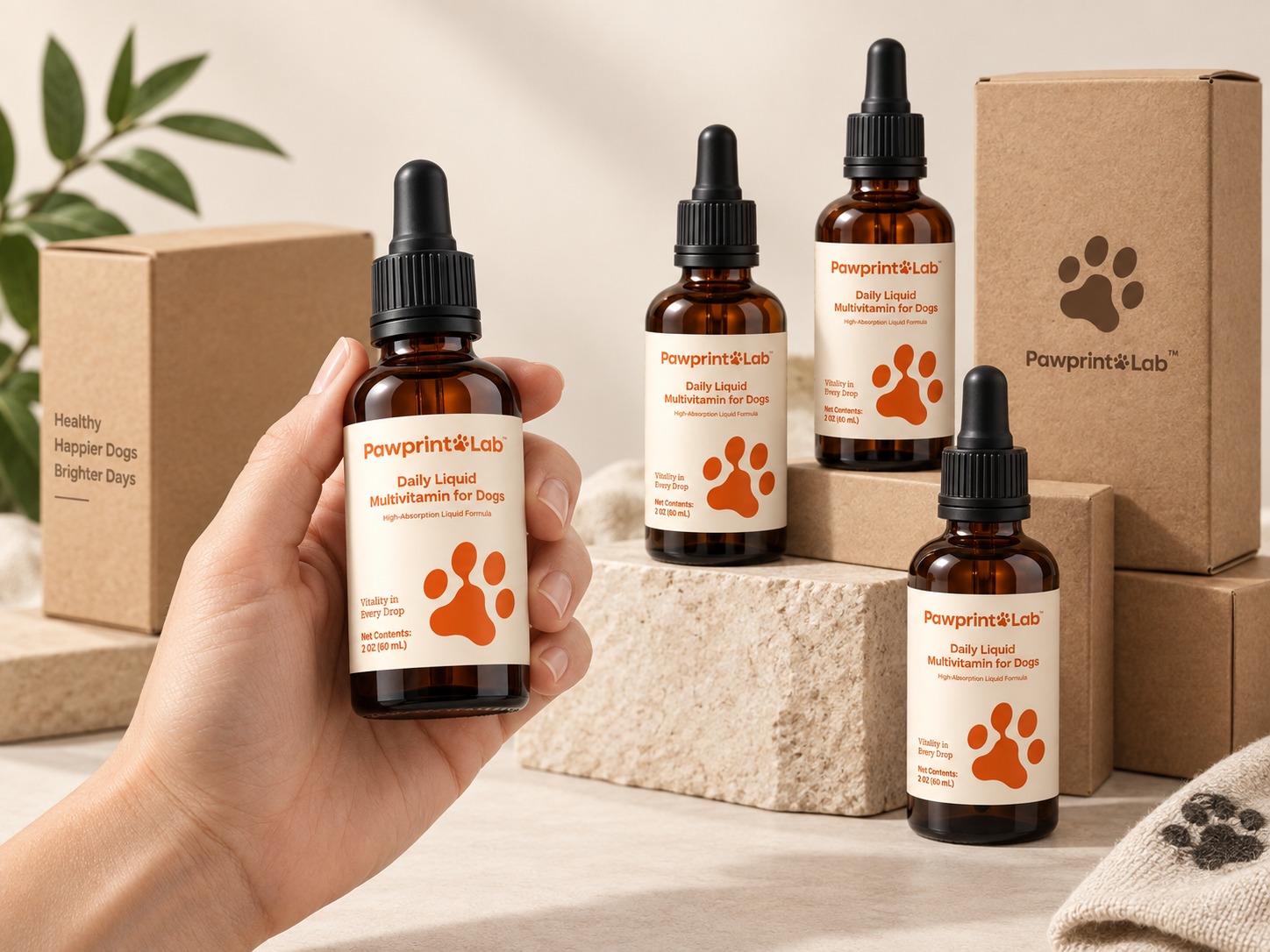
Pawprint Wellness Protocol is made and shipped from the USA, with domestic and imported ingredients. Over 100,000 units sold. Rated 4.6 on Trustpilot. Reviewed by Dr. Mark Saraiva, DVM.
Right now, through the subscribe-and-save option on pawprintlab.com:
Subscription pricing at time of writing:
Every order is backed by a 90-day money-back guarantee. Try it. Give it the three months. If your dog's mornings don't feel easier, if the strides don't look smoother, if you don't see the version of your dog you were hoping to see - you get your money back. Historically, fewer than 1% of customers ask.
Availability note: Due to recent demand, certain inventory batches may sell out. If you've been on the fence, this is the moment to lock in.
The reason this article exists isn't to make you feel guilty about the bag of food in your pantry.
It's to make sure you're not fighting a two-front battle with one hand tied behind your back. Adding glucosamine while ignoring the fatty-acid environment is like putting a new engine in a car and forgetting to change the oil. The parts are right. The system around them wasn't set up to help.
Pawprint Wellness Protocol was built to close that gap in one daily drop.
Check the label. Do the audit. Then give your dog the 90 days.


