


The New Zealand Mussel That's Quietly Rewriting Everything American Dog Owners Thought They Knew About Joint Support
A working-dog ingredient story most Americans have never heard - and what it reveals about the joint formulas sitting on your shelf right now.


It Started With A Sheepdog That Refused To Slow Down
On the South Island of New Zealand, there's a stretch of green hill country where border collies work sheep from sunrise until the light bleeds out of the sky. These aren't pampered house pets. They're athletes. They run miles a day, most days of the year, over uneven ground, well into what most American vets would politely call "senior."
And the shepherds who work them have a running joke: their dogs age slower than the ones back in the cities.
For a long time, people assumed it was the lifestyle. The fresh air. The exercise. The lean diet. All of that matters, sure. But over the last two decades, veterinary researchers noticed something else these working dogs had in common - something that had nothing to do with how far they ran or how clean their air was.
It was what they ate.
Or more specifically, what got quietly worked into their food from a very particular corner of the New Zealand coastline.
A shellfish with a green edge on its shell. Locally called the kuku. Globally, it's known as the New Zealand green-lipped mussel.

Why This Little Green Shell Grabbed The Attention Of Every Serious Joint Researcher On The Planet
Here's what makes the green-lipped mussel interesting - and why it's showing up in Reddit threads full of desperate owners of aging dogs, in veterinary journals, and in whispered conversations at agility trials.
It isn't just another source of glucosamine.
It's one of the few natural ingredients on Earth that carries multiple joint-support compounds in the same package: a rare type of marine omega-3 fatty acid, plus the structural building blocks the body uses to maintain cartilage, plus naturally occurring compounds that support a healthy inflammatory response.
That combination is the key. Because for decades, the joint-support industry - both human and canine - has been playing a one-note song. Glucosamine. Glucosamine. Glucosamine. Maybe chondroitin if the label was feeling fancy.
And the working-dog world quietly figured out something the mass market missed:
Joints don't break down through one pathway. So they don't get supported through one pathway either.
The Uncomfortable Truth About The Joint Chew In Your Kitchen Cabinet
Walk into any pet store in America and look at the joint supplement aisle. It's a graveyard of soft chews and bacon-flavored powders, and probably 90% of them are doing the same thing: dumping a moderate dose of glucosamine into a treat and calling it a day.
Which is a little like handing someone a single brick and telling them to build a house.
Glucosamine is a useful raw material for cartilage. Nobody's arguing against it. The problem is that a dog's joint is a complicated piece of machinery - cartilage, synovial fluid, tendons, ligaments, muscle attachments, blood supply, inflammatory signaling - and asking one ingredient to look after all of it is asking too much.
Meanwhile, the owners of working dogs (the ones whose animals literally have to keep moving to earn their keep) figured out years ago that the winning strategy is a stack. Not a single hero ingredient. A team.
Structural support for the cartilage itself. Marine fats to help the body manage everyday inflammatory signaling. Antioxidants to protect the cells doing the repair work. Cofactors for energy and muscle. Nutrients for skin, coat, and immune balance - because a dog is a whole animal, not a joint on legs.
That's the real lesson buried inside the green-lipped mussel story. The mussel is famous because it happens to carry several of those puzzle pieces in one shell. But the underlying idea - multi-pathway support - is the part that actually matters.
Which brings me to why I'm writing this.
What To Actually Look For In A Joint And Wellness Formula (Regardless Of What You End Up Buying)
Before I tell you what I recommend, I want to give you the checklist. Because even if you decide none of this is for you, you should know what a serious joint and wellness formula looks like versus what a marketing gimmick looks like.
Here's what I'd want on the label:
1. Real, disclosed doses of the structural joint ingredients. Glucosamine, chondroitin, MSM, and hyaluronic acid should all be listed - with actual milligrams next to them, not a proprietary blend hiding the numbers.
2. Marine omega-3s with EPA and DHA broken out. Fish oil is only as good as its EPA/DHA content. If a label just says "fish oil" and won't tell you the split, that's a red flag.
3. Antioxidant support. Vitamin E and turmeric are two of the most well-studied. They protect the tissues doing the daily rebuilding.
4. Cofactors for energy, skin, coat, and immune health. L-carnitine, zinc, beta-glucans. These are the ingredients that separate a "joint chew" from a genuine daily wellness formula.
5. A delivery format your dog will actually take. This is the one nobody talks about. The best formula in the world is worthless if your dog spits it out or picks around it in his bowl.
6. Weight-based dosing. A 9-pound terrier and a 90-pound shepherd should not be getting the same scoop.
Now. When I started applying that checklist to what's actually available on the American market, the list got short fast.
One name kept coming back.
Meet Pawprint Wellness Protocol
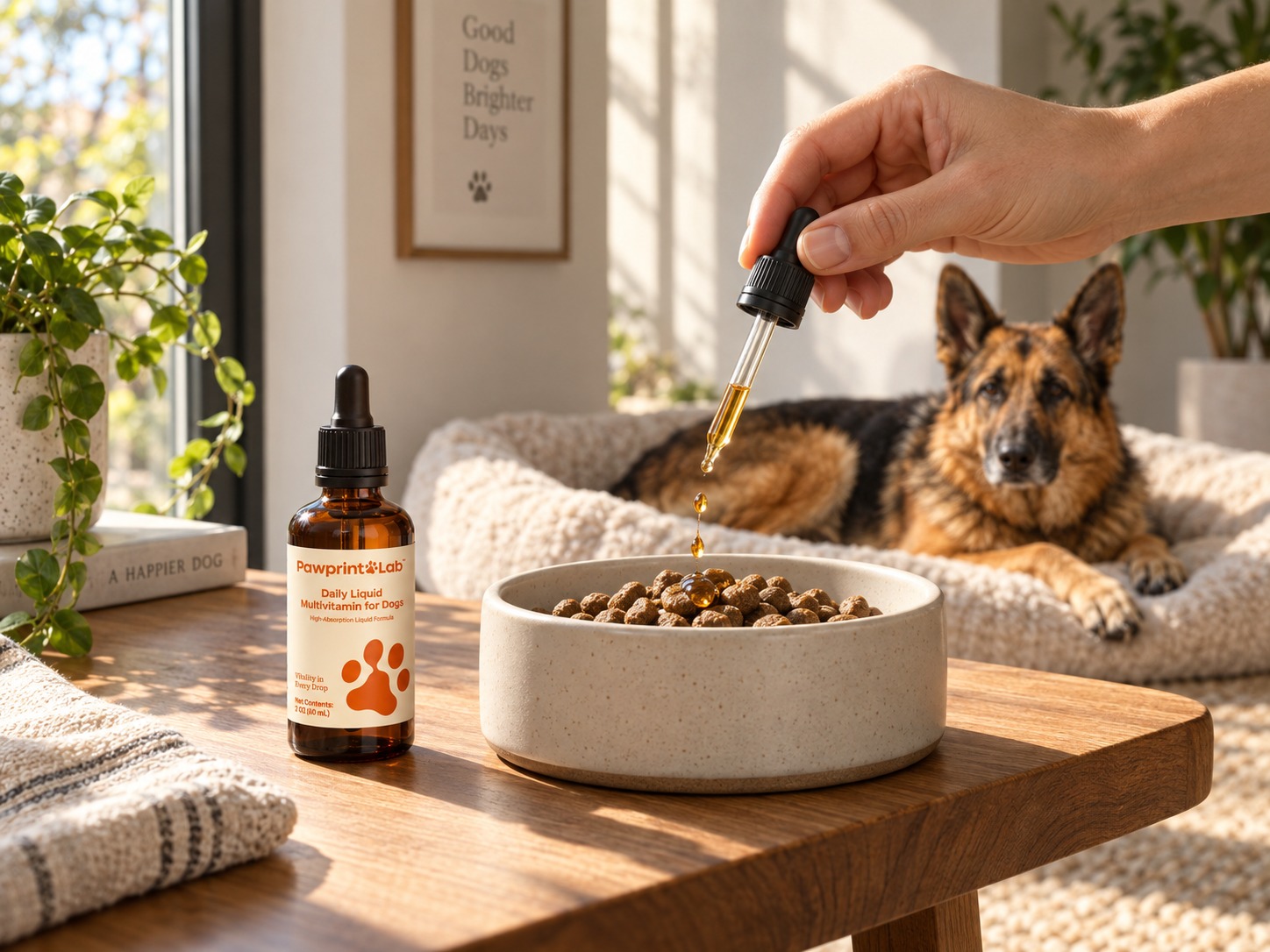
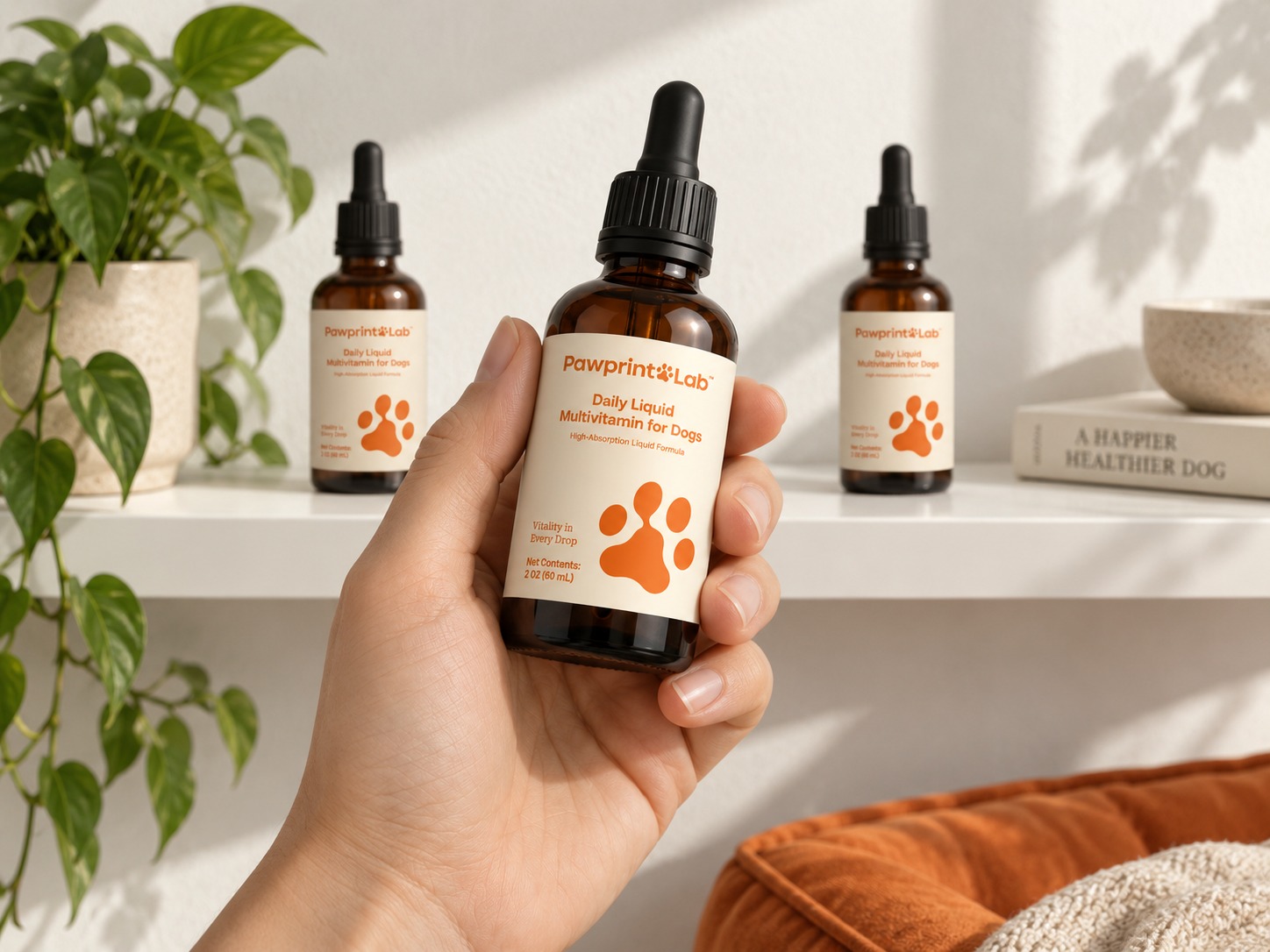
Pawprint Wellness Protocol is a daily liquid multivitamin for dogs, made by Pawprint Lab in the USA. It's a 2 fl oz (60 mL) amber dropper bottle. You add it to your dog's food. That's it. No chews. No powders. No pills to wrestle into the back of his throat.
Now, before we go any further, I want to be direct about something the brief for this piece told me to be direct about:
Pawprint Wellness Protocol does not contain green-lipped mussel.
I opened with the mussel story because it's the doorway into the idea - the idea that a serious joint and wellness strategy isn't one ingredient, it's a stack. Pawprint's stack is different from what a New Zealand shepherd might feed. But the philosophy is the same: multi-pathway support, in doses that are actually disclosed, in a format a dog will actually consume.
Here's what's in every 1 mL dropper:
- Glucosamine HCl - 500 mg
- Chondroitin Sulfate - 250 mg
- MSM (Methylsulfonylmethane) - 200 mg
- Hyaluronic Acid - 25 mg
- Fish Oil (EPA/DHA) - 300 mg (180 mg EPA + 120 mg DHA)
- Beta-Glucans (β-1,3/1,6) - 100 mg
- Turmeric Extract (95% Curcumin) - 75 mg
- L-Carnitine - 100 mg
- Zinc (Amino Acid Chelate) - 15 mg
- Vitamin E - 25 IU / 16.75 mg
Ten actives. Five areas of support: joint comfort, energy and muscle function, inflammation balance, immune health, and natural repair.
It's the formula I would have designed if I'd sat down with the checklist above and refused to compromise.
Why The Liquid Format Matters More Than You Think
I want to spend a second on this because it's the thing owners underestimate over and over again.
You can have the perfect ingredient list. If your dog won't take it consistently, it doesn't matter.
Chews are a gamble. Some dogs love them. Some pick them out of the bowl and leave them next to the water dish like a tiny insult. Powders clump. Pills require a wrestling match and half the time end up in the couch cushions.
A liquid dropper solves all of that. You squeeze the recommended number of droppers directly onto whatever your dog is already eating. He eats his dinner. He eats his supplement. You never think about it again. It's the closest thing to a "set it and forget it" wellness routine that exists in this category.
And the dosing is genuinely simple. Pawprint made it weight-based, four buckets, no math:
- Small dog (under 22 lb / 10 kg) - 1 dropper
- Medium dog (22-55 lb / 10-25 kg) - 2 droppers
- Large dog (55-88 lb / 25-40 kg) - 3 droppers
- Giant dog (88 lb+ / 40 kg+) - 4 droppers
Give it with food for higher absorption. Done.
The 90-Day Routine, In Plain English
I'm not going to promise you your dog will be doing backflips in a week. Anyone who does is lying to you.
What Pawprint's own timeline shows - and what makes sense with how joint and cellular support ingredients actually work - is a build. Daily use, consistent dose, patience.
Month one: Easier mornings. Smoother strides. A glossier coat is usually the first visible change, because skin and coat turn over fast.
Month two: Longer play sessions. Quicker responses when you call. Confidence on the stairs.
Month three: All-day pep. Bright eyes. That specific look older dogs get when the fog lifts - the "there he is" look every owner recognizes.
The 90-day window isn't marketing fluff. It's how long serious joint and wellness compounds need to accumulate in the body and do their work. This is also, not coincidentally, exactly why Pawprint backs the whole thing with a 90-day money-back guarantee. They want you to see the arc, not just try it for a week and quit.
The Details Most Brands Bury

A few things worth knowing before you decide:
- Made in the USA in a cGMP-compliant facility under 21 CFR Part 111
- Ships from a US warehouse, fast and free on subscriptions
- Not sold on Amazon - only at pawprintlab.com
- 100,000+ bottles sold
- Rated 4.6 on Trustpilot from 129 reviews
- Reviewed and recommended by Dr. Mark Saraiva, DVM
- Clean label: no dairy, no dyes, no GMOs. Inactive ingredients are purified water, natural flavors, vegetable glycerin, citric acid, and potassium sorbate.
- Shellfish sensitivity note: because glucosamine is typically shellfish-derived, dogs with a known shellfish allergy should skip this one.
What It Costs (And Why That's Actually The Interesting Part)
Here's where the math gets uncomfortable for the joint chew industry.
On the Subscribe & Save 30% off plan:
- 1 bottle - $48.99 (retail $69.99), about $1.63 per day
- 3 bottles - $131.96 (retail $188.52), about $1.47 per day
- 6 bottles - $239.96 (retail $342.80), about $1.33 per day
Free shipping on every subscription order. Cancel or pause anytime. No commitment games.
Think about that. For roughly the price of a fancy coffee, your dog gets ten clinically relevant actives - the joint stack, the marine omega-3s, the antioxidants, the immune and coat support - in one dropper, once a day.
If you tried to build this stack yourself out of separate bottles at the pet store, you'd be looking at five or six containers, five or six labels to keep track of, and a monthly cost that would make you close the browser tab.
That's the actual argument for a formula like this. Not that it's magic. That it's consolidated - and priced like the manufacturer wants you to stay on it long enough to see the change.
The Guarantee That Makes This Basically A Free Test Drive
Ninety days. Full money back.
Not thirty. Not a "restocking fee." Not "unopened bottles only."
Ninety days, use it, and if you don't see the changes Pawprint's timeline describes - the easier mornings, the smoother movement, the coat, the energy - you send it back and you're refunded.
Fewer than 1% of customers actually request a refund. Which is either the strongest possible endorsement or the world's most confident bluff. Either way, the risk of trying it is on Pawprint. Not on you.
Answering The Questions I'd Be Asking
"Wait - so does Pawprint actually contain green-lipped mussel or not?"
No. I said this above and I'll say it again because it matters. The mussel is the doorway into the multi-pathway idea. Pawprint's own marine and joint bridge is fish oil with EPA and DHA, plus glucosamine, chondroitin, MSM, and hyaluronic acid. Different source, same philosophy.
"Why not just buy glucosamine on its own?"
You could. It'd be cheaper by the milligram. But you'd be handing your dog a single brick and hoping he builds a house. Multi-pathway support exists because joints aren't a single-pathway problem.
"My dog is picky. Will he actually eat it?"
It goes on top of the food he already eats. Natural flavors, small volume (1-4 mL depending on size), vegetable glycerin base. Most dogs never notice it's there.
"Is this for senior dogs only?"
No. The best time to start is before you notice a problem. Joint and cellular support compounds work best as a preventive routine, not a rescue mission after mobility is already gone.
The Bottom Line
There's a reason a small green shell on a New Zealand coastline ended up rewriting the way researchers think about joint support. It wasn't the shell. It was the lesson inside it - that real support comes from a stack, not a single ingredient, and that the owners who understand this get to keep their dogs moving, playing, and showing up for years longer than they should.
You don't have to fly to New Zealand to give your dog that same advantage.
You can start tonight. With dinner. One dropper on the food he was already going to eat.
Ninety days to see what changes. Zero risk if it doesn't.
Pawprint Wellness Protocol is manufactured in the USA in a cGMP-compliant facility under 21 CFR Part 111. Reviewed by Dr. Mark Saraiva, DVM. Rated 4.6 on Trustpilot from 129 reviews. 100,000+ units sold. 90-day money-back guarantee. Available exclusively at pawprintlab.com.