
A closer look at the multi-system approach owners are now using at home after monthly injections and standard supplements stop producing enough change.

Bailey was nine years old the morning his owner, a schoolteacher named Karen, watched him stop dead at the top of the porch steps.
He looked down. He looked back at her. And then he sat.
This was the same dog who used to launch himself off that porch to chase squirrels. The same dog who pulled her down the sidewalk on his morning walk. Now he was sitting at the top of three shallow steps, waiting for her to come lift his back end.
She had done everything the vet suggested. Monthly injections. A glucosamine chew every morning. Fish oil capsules pierced and squeezed onto his food. A prescription joint diet. A softer bed. Ramps. Rugs on the hardwood.
Each thing helped a little. None of them, stacked together, brought her dog back.
"I felt like I was managing a decline instead of stopping one," she told me later. "I had five different products on the counter and my dog still looked old."
If any of that sounds familiar - if you're the person with the drawer full of half-used bottles, the person who has genuinely tried - this article is written for you.
Start the complete routine →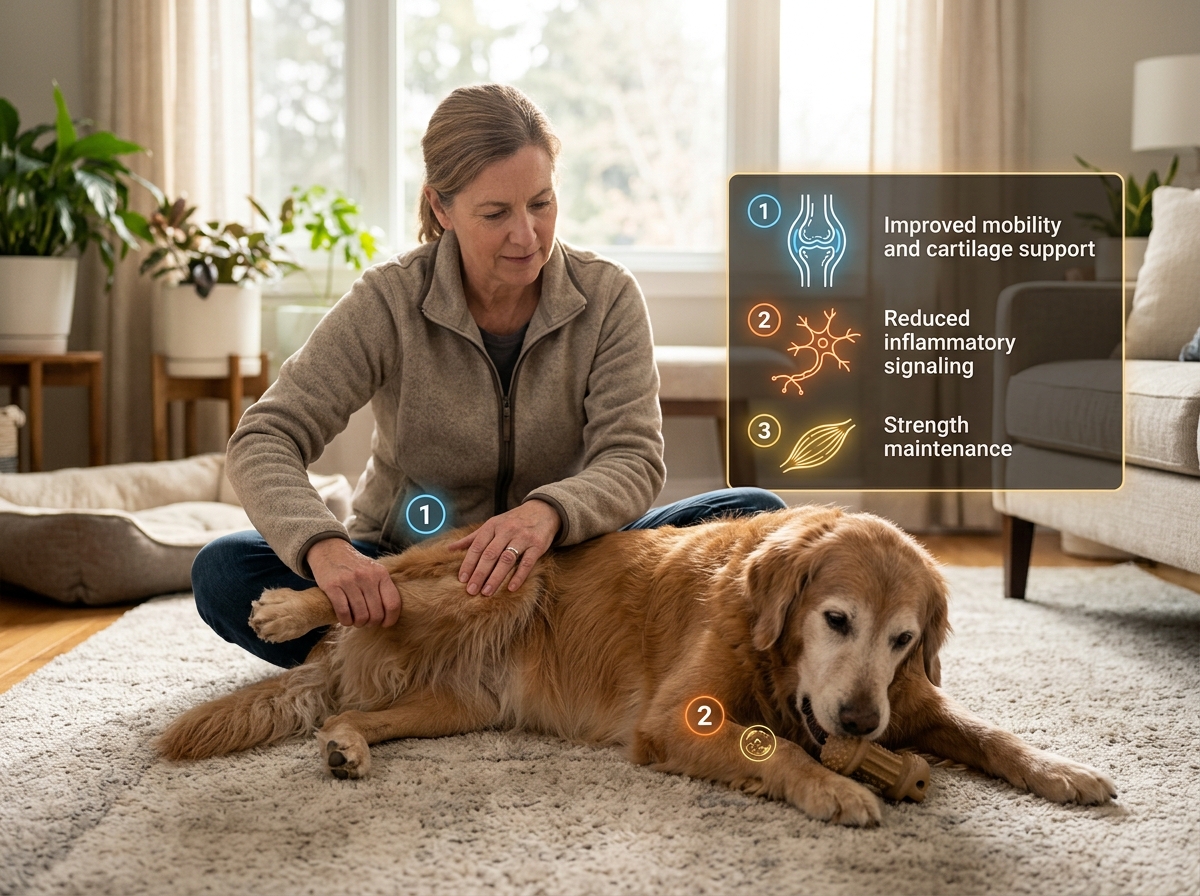
Here's what I want you to sit with for a minute.
Most owners in Karen's situation are told the problem is joints. So they buy a joint product. When the joint product isn't enough, they're told to buy a stronger joint product. When that isn't enough, they add injections. When that isn't enough, they add another chew on top.
Every single one of those interventions is aimed at the same target: cartilage.
But an aging dog isn't declining because of cartilage alone. He's declining because several connected systems are all sliding at the same time - and each one is dragging the others down with it.
That's not a marketing line. That's how rehab and sports-medicine professionals actually think about a stiff, slowing, less-playful senior dog. They call it multi-modal. It means: you don't fix a system-level problem with a single-lever tool.
If you've been pulling one lever harder and harder and wondering why your dog still looks tired, stiff, or "off," this is the reason.
Picture your dog's daily movement as a table with four legs. If one leg is short, the whole table wobbles - no matter how strong the other three are.
Here are the four legs.
1. Joint structure. The cartilage, cushion, and fluid inside the joint capsule. When this thins out, every step delivers a little more bone-on-bone friction. Glucosamine, chondroitin, MSM, and hyaluronic acid are the classic building-block nutrients here. This is the leg most owners are already trying to prop up.
2. Inflammation balance. Even after you support the joint itself, low-grade inflammation keeps the tissue irritated, the movement guarded, and the recovery slow. Omega-3 EPA and DHA, turmeric extract, and vitamin E are the nutrients that show up over and over in this bucket. Miss this leg, and the joint work you're doing gets partially cancelled out every day.
3. Muscle and energy function. A stiff dog moves less. A dog that moves less loses muscle. A dog with less muscle puts more load through the joints he was already trying to protect. It's a spiral. L-carnitine helps the body convert fat into usable energy for muscle work, and zinc supports the tissue-level recovery that keeps that muscle from wasting.
4. Immune health and natural repair. The body's ability to clean up, patch up, and bounce back after normal daily wear. Beta-glucans (β-1,3/1,6), zinc, and vitamin E are the workhorses here. This is the leg nobody thinks about - and it's often the reason a dog "just seems old" even when everything else is being managed.
Look at that list. Notice something?
Every single one of those systems needs a different nutrient family. Which is exactly why the honest owner ends up with five bottles on the counter and a dog who still won't do the stairs.
Build the daily protocol →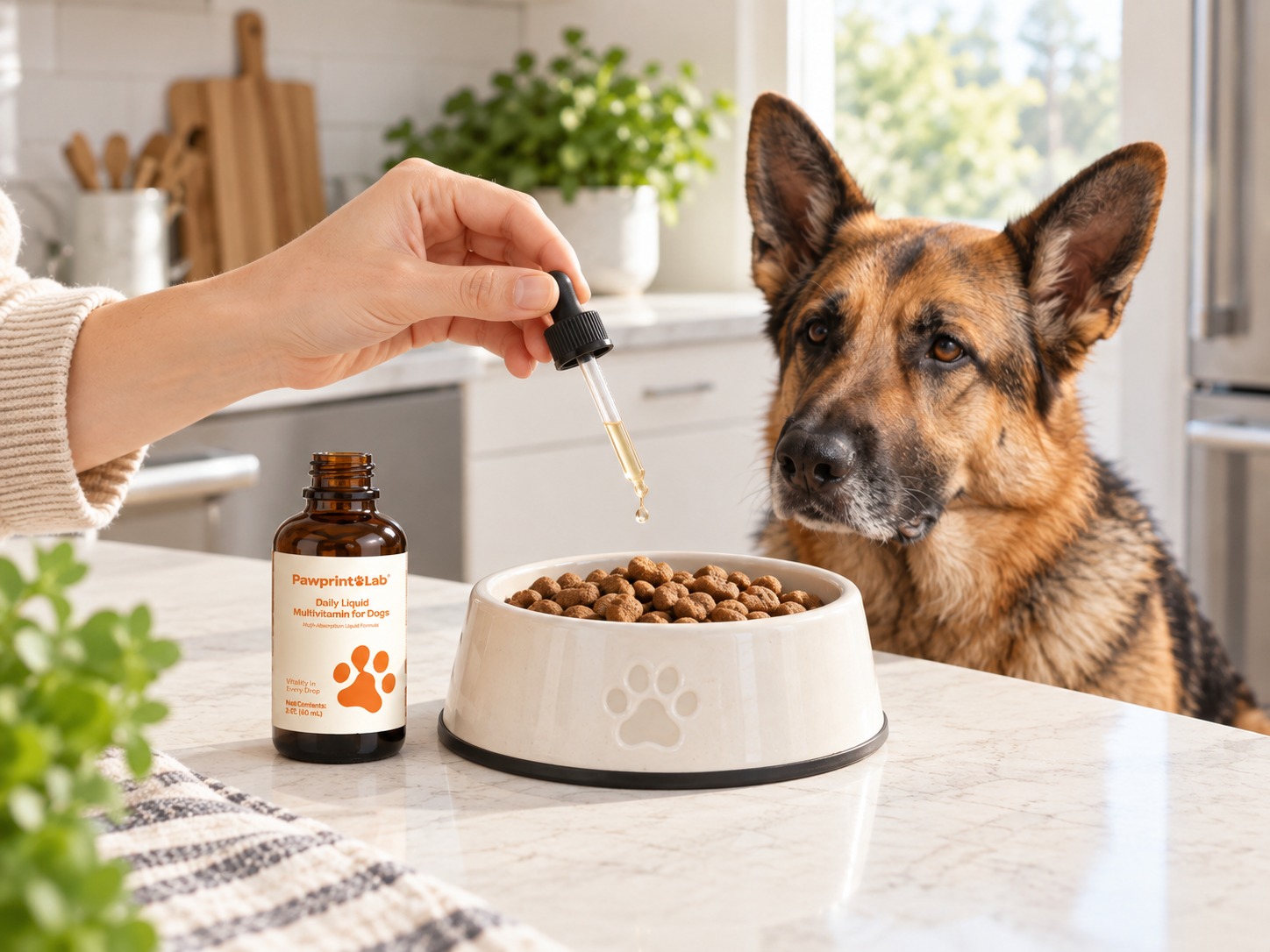
Talk to anyone who works with dogs in a rehab or recovery setting and you'll notice the language changes.
They don't say "let's treat the hip." They say "let's support the whole pattern."
They think in terms of joint capsule and soft tissue and muscle tone and inflammatory load and daily recovery. They know that if you only address one, the others will pull the dog back down within weeks.
That's the multi-system mindset. And for years, replicating it at home was basically impossible unless you were willing to:
Most owners don't fail because they don't care. They fail because the logistics of running a multi-system routine, from your kitchen, without a clinic staff behind you, are brutal.
That's the gap the Pawprint Wellness Protocol was built to close.
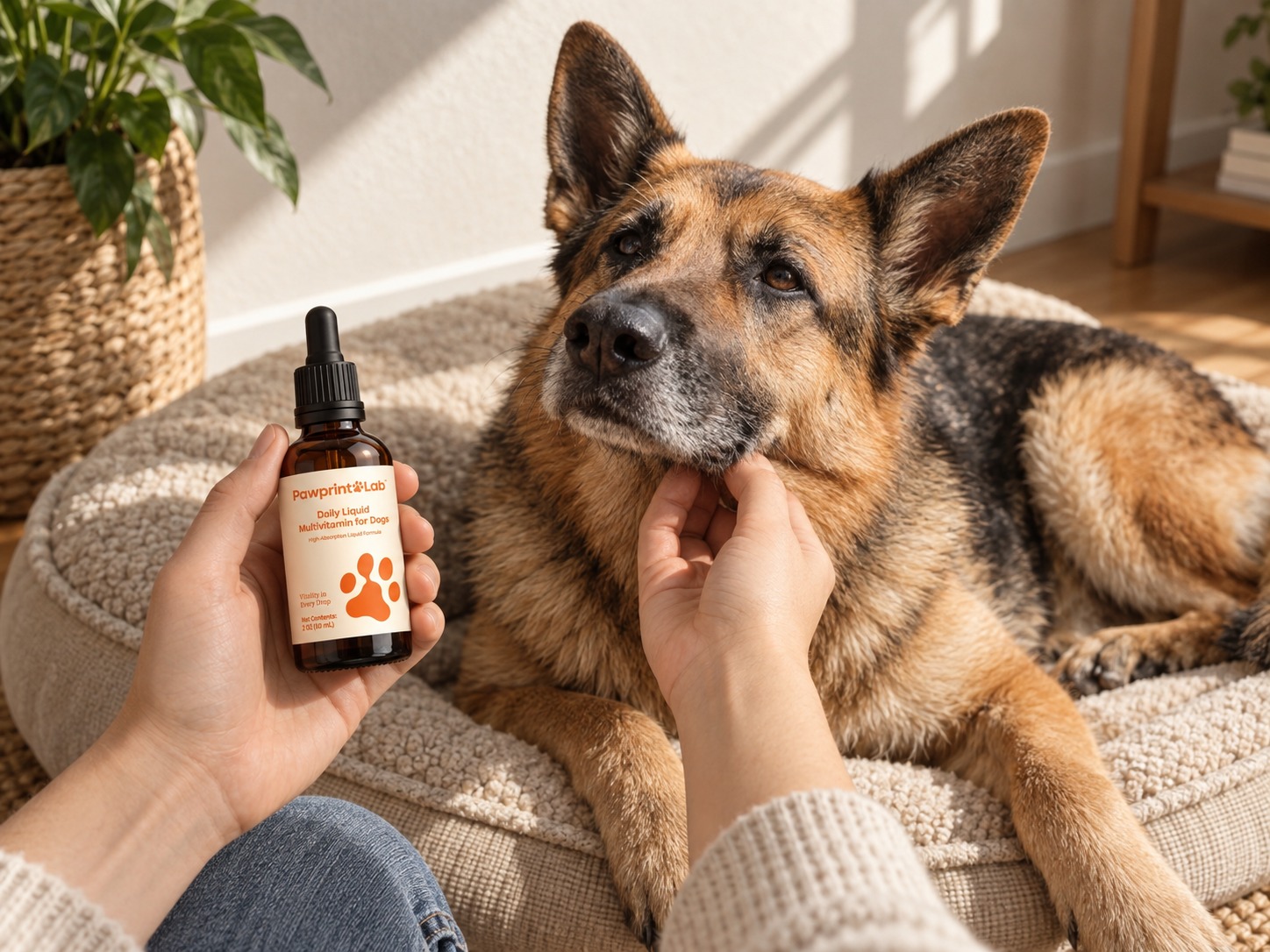
Pawprint Wellness Protocol is a daily liquid drop supplement for dogs, formulated by Pawprint Lab and reviewed by Dr. Mark Saraiva, DVM.
It's not "another joint chew." It's a single dropper bottle that carries the working ingredients from all four of those systems above - in one daily dose you add to your dog's food.
Here's how the formula maps to the multi-system approach, organized by job rather than by label order.
These are the raw materials the joint capsule uses to stay cushioned and glide smoothly. This is the bucket most standard "joint" products stop at. In Pawprint, it's the starting line.
This is the bucket that quietly undoes the joint work when it's missing. Balancing everyday inflammatory signals is what allows the rest of the routine to actually show up in how your dog moves.
If your dog has been moving less, he's lost tone. Rebuilding that tone - so he can carry his own frame with less joint strain - is a nutrient job, not a willpower job.
The quiet layer. The one that decides whether your dog spends the week bouncing back or sliding backward.
All of it. In one bottle. In one dropper. Once a day.
Start the complete routine →One of the reasons multi-supplement routines fall apart at home is dosing. Every product has a different chart, a different serving, a different weight bracket. It becomes a part-time job.
Pawprint uses a single weight-based dropper system.
Add it to food. That's the whole routine. There are no chews to negotiate with a picky senior, no pills to hide in cheese, no powders that sink to the bottom of the bowl.
The bottle is 2 fl oz / 60 mL. It carries approximately 60 mL total, and each 1 mL serving delivers the full active-ingredient stack listed above.
This is the honest timeline. Every dog is different, and daily consistency is the whole game.
Before starting: Shorter walks, careful movement, dull coat, hesitation on stairs.
Month 1: Easier mornings. Smoother strides. A glossier coat is often the first visual signal that the omega-3s and vitamin E are landing.
Month 2: Longer play windows. Quicker responses when you call. More confidence going up and down stairs.
Month 3: All-day pep. Bright eyes. The dog you remember, showing back up in small, repeated ways throughout the day.
That's the reason the routine is built to run for at least 3 months. The joint bucket, in particular, tends to show its fullest change between weeks 8 and 12, not in the first week.
Good. Keep the mindset - upgrade the tool.
Glucosamine is one lever inside one of four systems. If it were the whole answer, dogs on glucosamine chews wouldn't still be sitting at the top of the porch steps. Pawprint keeps glucosamine at 500 mg per mL and adds the other three systems around it, so you're finally working the whole table instead of one leg.
Then Pawprint isn't a replacement - it's the daily at-home routine that runs alongside what you're already doing. It's a wellness protocol, not a medical claim. If you're in active treatment, loop your vet in. That's how any thoughtful owner should approach a new addition to their dog's daily food.
Because five bottles on a counter is how routines die. Consolidation isn't a marketing gimmick - it's the reason owners actually stay consistent long enough to see the multi-system effect compound.
Run the full protocol for up to 90 days. If you don't see the kind of changes your dog deserves - the easier mornings, the longer play, the confident stairs - you get your money back. Historically, fewer than 1% of owners ever ask.
That means the entire risk of finding out whether the multi-system approach works for your dog sits with Pawprint, not with you.
You've already tried the single-lever approach. You know what it did and what it didn't do.
The question isn't whether you love your dog enough. You do. You wouldn't be reading this far if you didn't.
The question is whether you want to keep managing a decline with five bottles on the counter - or whether you want to run the multi-system routine the way rehab professionals think about it, in one daily dropper, for the next 90 days, and find out what your dog actually has left in him.
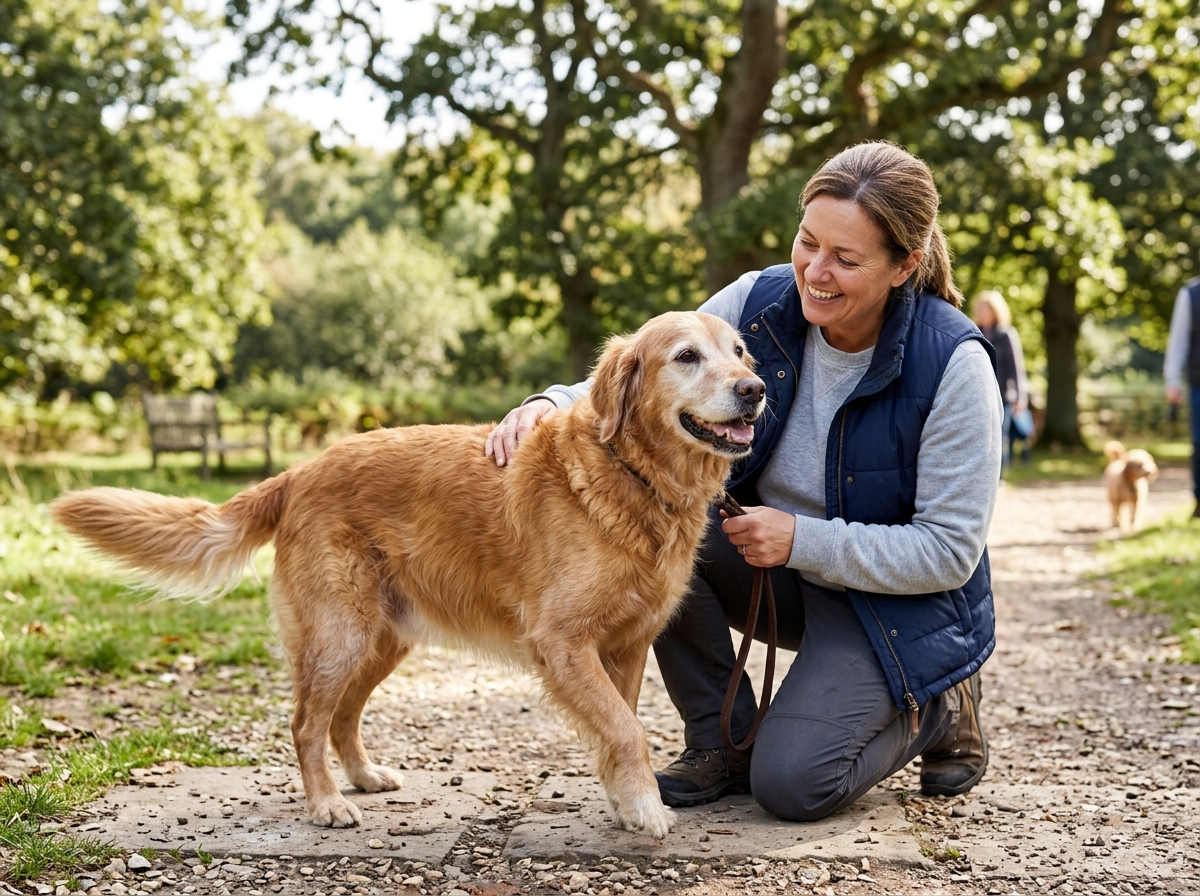
Karen ran it for Bailey. Three months later, she sent a video of him trotting down those same porch steps on his own. Not sprinting. Not launching. But moving. Choosing to move.
That's the goal. Not a miracle. A dog who chooses to move again.
Build the daily protocol - Start today with 30% off →*Pawprint Wellness Protocol is a daily wellness routine and is not intended to replace veterinary care. Reviewed by Dr. Mark Saraiva, DVM. Progress builds with daily use; every dog is different. 90-day money-back guarantee. Available only at pawprintlab.com.


