


If your dog has been moving a little slower lately - taking the stairs one at a time, hesitating before jumping on the couch, or just seeming "off" during walks - there's a simple 30-second observation you can do at home tonight, before you spend another dollar at the vet or on another supplement that might not even target the real problem.
It's called the Tomato Test.
And once you understand what it's actually showing you, you'll never look at your dog's stiffness the same way again.
Here's what happens in almost every household with a dog over the age of 5.
The dog starts slowing down. The owner notices. But the changes are so gradual - a half-second pause here, a shorter walk there, a groan getting up from the dog bed - that the owner tells themselves the same story most owners tell themselves:
"He's just getting older."
That story feels safe. It also happens to be the exact reason so many dogs end up with problems that were preventable, if only the owner had known what to look for and when to act.
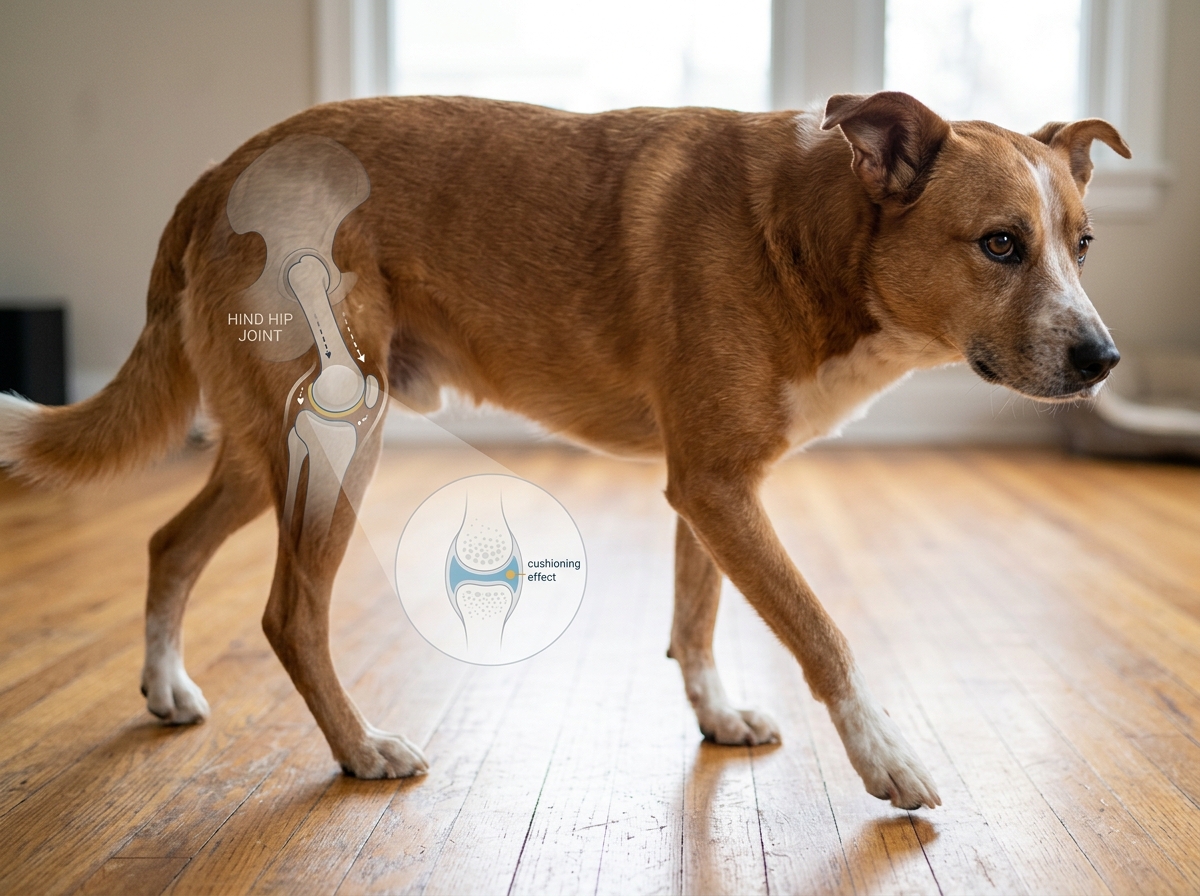
Because here's the truth: "slowing down" isn't one thing. It can mean two very different things, and they call for two very different responses.
If you treat #2 like #1 - "he just needs to rest" - you lose months. Months where the cartilage keeps thinning. Months where the inflammatory cycle keeps compounding. Months where your dog quietly compensates by shifting weight, which stresses the other joints, which then also start to break down.
The Tomato Test is the simplest observation I've seen for helping an owner tell the difference at home.
The idea is borrowed from something you already do without thinking about it.
When you walk into a grocery store and pick up a tomato, you don't crush it. You don't poke it with your fingernail. You just press gently with the pad of your thumb to feel whether it gives a little, or whether it feels firm and resistant underneath.
That gentle, curious pressure - the same pressure you'd use on a ripe tomato you don't want to bruise - is exactly the pressure you're going to use on your dog.
This isn't a diagnosis. Let me say that again, clearly, because I don't want anyone getting the wrong idea:
This is an observation, not a diagnosis. A diagnosis comes from a vet with imaging and hands trained on thousands of dogs. What you're doing is gathering better information so that when you do talk to your vet - or when you're deciding what to do next at home - you're not guessing blind.
Set aside 30 seconds. Get your dog somewhere calm - the dog bed, the living room rug, wherever they're relaxed. Kneel down next to them.
Step 1 - Warm-up touch.
Run your hand along their body the way you normally would when you pet them. You want them relaxed, not braced. If they tense up before you've even started, wait a minute and try again.
Step 2 - Muscle press (the "tomato" pressure).
On the leg you're checking, press gently into the meaty part of the muscle - the thigh, the shoulder, the upper arm. Not the joint itself. Just the muscle belly. Use the pad of your thumb, with the same pressure you'd use to check if a tomato is ripe.
Watch and feel for:
Step 3 - Joint press.
Now move to the joint itself - the knee, the hip area, the elbow, the shoulder joint. Same pressure. No harder. Just curious, gentle pressure with the pad of your thumb or two fingers around the joint line.
Watch for the same signals.
Step 4 - Compare.
This is the whole point.
That last pattern is the one most owners have and don't realize it.
When I've walked owners through this, the reaction is almost always the same.
They start out thinking, "He's fine, he's just old." Then they do the muscle press. No reaction. Then they do the joint press on the hip or the knee. And suddenly the dog turns his head, or shifts his weight, or gives that quiet look that says "please don't."
And the owner's whole understanding of the problem changes in about 15 seconds.
Because now it's not "he's just getting old." Now it's "the joint itself is asking for help." That's a completely different problem with a completely different solution.
A muscle strain is usually a bad landing, a slip on the hardwood, a rough game of tug. The tissue is inflamed. It heals in days to a couple of weeks. Rest, gentle movement, and time do most of the work.
Joint involvement is different. The cartilage that cushions the ends of the bones is slowly thinning. The synovial fluid that lubricates the joint is thinner and less protective. Inflammatory signals inside the joint capsule are running higher than they should. And the body's natural repair systems are falling behind the daily wear.
That's not a "rest it out" problem. That's a "feed the joint what it needs to keep up" problem. Every day. Consistently.
Which brings us to the next question every owner asks once they realize what they're actually seeing.
Once the Tomato Test tells you the joint is involved, you have three broad options.
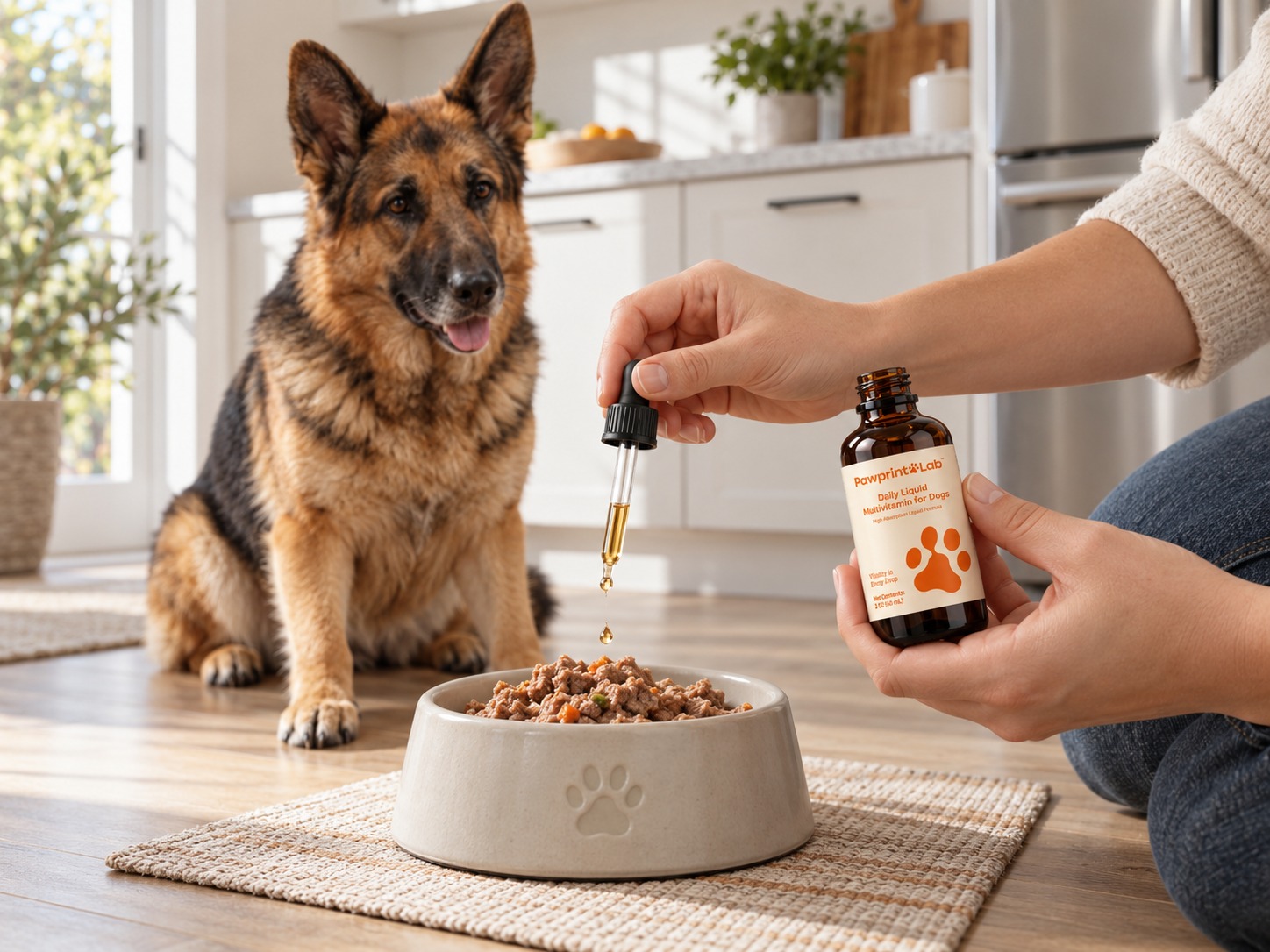
Option 3 is where most owners get stuck. Not because they don't want to help. But because "joint support" for dogs has turned into a mess.
You've got a glucosamine chew from one brand. A fish oil pump from another. A turmeric capsule you have to hide in cheese. An MSM powder that the dog sniffs and walks away from. A hyaluronic acid tablet that shows up in the dog bed three hours later. Five different bottles. Five different routines. And the honest truth? Most owners give up within a month because the routine is impossible to keep consistent.
That's the exact problem Pawprint Wellness Protocol was built to solve.
Pawprint Wellness Protocol is a daily liquid drop supplement for dogs. One amber dropper bottle. One routine. One formula that covers what five separate bottles used to cover.
It's not a chew. It's not a powder. It's not a pill you have to wrap in peanut butter and pray about.
It's a liquid you add to the food your dog already eats, at dinnertime.
That matters more than people realize. Because the real reason most joint supplements "don't work" isn't the formula - it's that the dog stops taking them, or the owner stops giving them, within a few weeks. Consistency is the whole game. And liquid drops on food are the most consistent format there is.
Here's what's in every 1 mL dropper:
That's ten active ingredients working across five areas of daily support: joint comfort, energy and muscle function, inflammation balance, immune health, and skin & coat.
See the Full Wellness Protocol Formula →Glucosamine, chondroitin, MSM, and hyaluronic acid feed the cartilage and joint cushion. This is the structural side - the raw materials the joint needs to keep the surfaces smooth and the movement confident.
EPA/DHA omega-3s, turmeric, and vitamin E work on the inflammatory side. They help balance the everyday inflammatory signals inside the joint capsule and protect the surrounding tissue while the body does its repair work.
L-carnitine, zinc, and beta-glucans support the systems around the joint - steady muscle energy so the dog can move without compensating, skin and coat quality so the whole animal looks and feels healthier, and immune readiness so the daily repair process has what it needs.
Every ingredient has a job. Nothing is filler.
One of the biggest reasons owners quit supplements is that they can't figure out how much to give.
Pawprint solves that with weight-based drops:
Give it with food for higher absorption. That's the entire routine. Dinner, drops, done.
Every dog is different, and daily consistency is what makes the difference. But here's the pattern most owners describe:
That's the reason we ask owners to commit to the full 90-day window before making a judgment. Joint tissue takes time to respond. Consistency wins.
Start the 90-Day Pawprint Protocol →Three reasons.
1. Absorption. Liquid formats have less "breakdown time" in the stomach and generally deliver ingredients to the system more efficiently than compressed chews or pills.
2. Consistency. A dog can spit out a chew. A dog can refuse a pill. A dog can pick around a powder. What no dog does is refuse the food they already love, which is where the drops go.
3. Dosing precision. Weight-based droppers mean the small dog gets what the small dog needs, and the giant dog gets what the giant dog needs. No breaking pills in half. No guessing.
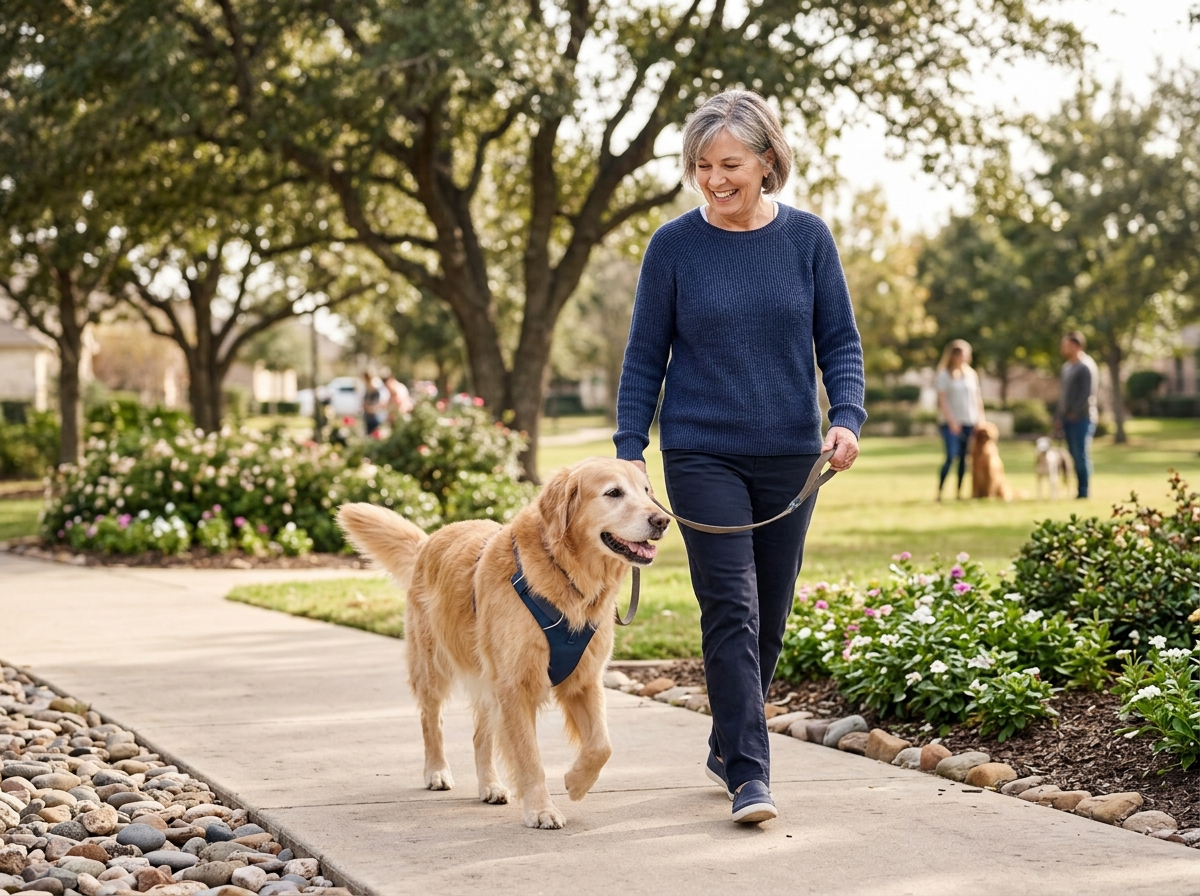
Pawprint Wellness Protocol is reviewed by Dr. Mark Saraiva, DVM. It's rated 4.6 on Trustpilot across 129 reviews, with 100,000+ units sold.
It's manufactured in a cGMP-compliant facility under 21 CFR Part 111 standards, made and shipped from the USA with domestic and imported ingredients. No dairy, no dyes, no GMOs. (Owners with dogs sensitive to shellfish should check the glucosamine source before starting.)

Pawprint is sold only at pawprintlab.com - not on Amazon, not in retail. That's how the brand keeps the formula controlled and the price honest.
Right now, when you subscribe & save, you get:
The subscribe & save pricing works out to roughly $1.33–$1.63 per day depending on the bundle you choose. That's less than most people spend on coffee to keep the joint of a family member you love actually functioning.
Claim the 30% Off Subscribe & Save Offer →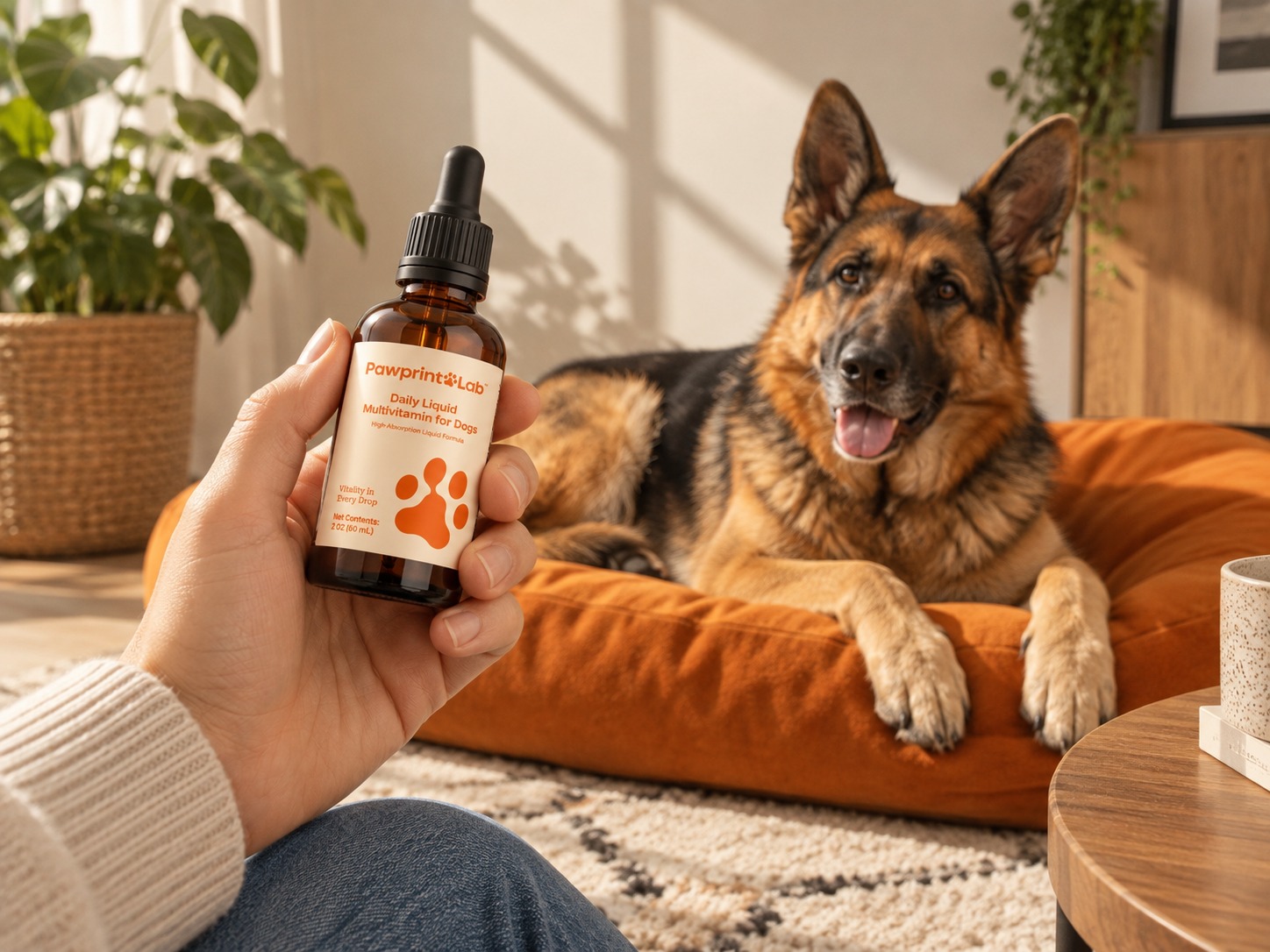
The Tomato Test takes 30 seconds. It won't diagnose your dog. But it will change what you see the next time your dog gets up from the dog bed a little slower than they used to.
And once you see it, you have a choice.
You can wait, and hope, and tell yourself the same story most owners tell themselves.
Or you can give your dog's joints - and immune system, and coat, and energy - what they structurally need every single day, in the one format your dog will actually take, backed by a 90-day guarantee that puts the risk on us, not on you.
More play. Less pain. Longevity starts here.
Start the Pawprint Wellness Protocol - 30% Off Today →


